
An Exponential Cascade, Upwards and Out
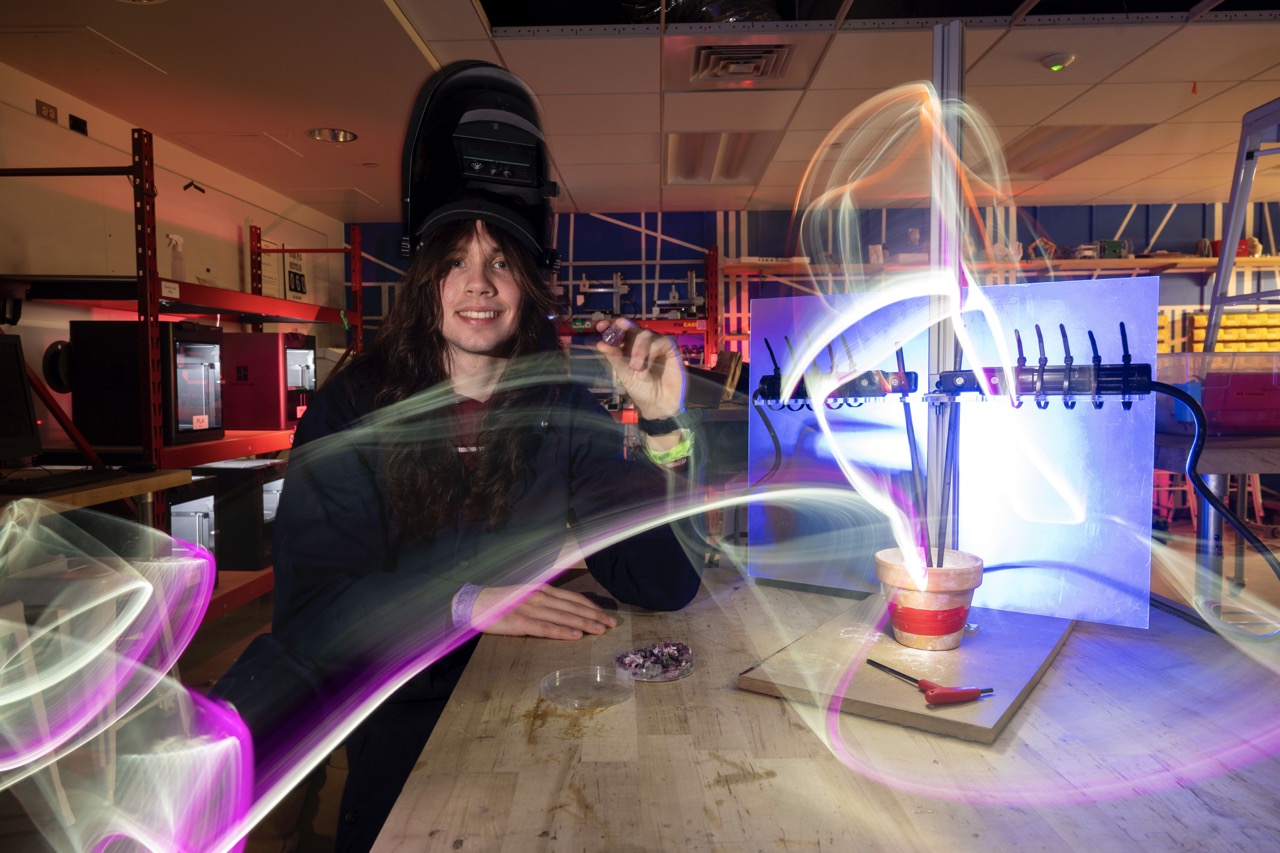
Just before submitting his application to the University of Pittsburgh, Jonathon (Jack) Bender changed his intended major. His original plan was history, but a few of Bender’s high school science and math teachers had seen his potential and turned him toward STEM. Plus, he’d spent a great deal of time in his backyard conducting experiments with his dad. He chose “engineering” and clicked Submit.
Now finishing his third year in chemical engineering at the Swanson School of Engineering, Bender can be found, quite literally, all over Benedum Hall. A mentor at Pitt Makerspaces, a vice president of the Hydroponics Club, and an endlessly curious researcher making rubies on the loading dock or transforming a 3D printer on the ninth floor, he has found his place.
The basement
Bender, who grew up outside of Philadelphia, reached the semifinals of the National History Bee in eighth grade. “I was always good at history, but throughout middle school, I wasn’t pushed in science,” he recalled. “It wasn’t until my junior year of high school, when I took AP chemistry from a great teacher, that I realized I could do it.”
Uninterested in passively learning, Bender “dove down a rabbit hole on YouTube.” He found inspiration watching scientists create lasers and make synthetic rubies.
“I started trying to make rubies with a blowtorch and a crucible in my backyard, with my dad. It didn’t work,” Bender said. “The rubies didn’t go anywhere until I came to Pitt.”
As a first-year student at the Swanson School, Bender gravitated toward the Makerspaces in the Benedum Hall basement. Filled with 3D printers, laser cutters, heat presses, sewing machines, and other tools, the Makerspaces became his second home. After his first semester, he became a Makerspaces mentor, helping his peers design and create.
He also joined Pitt Hydroponics, a club that has built a garden where tomatoes and greens thrive outside the Makerspaces. Bender was eager to learn about hydroponics and how to build growing systems.
From the basement to the loading dock
If Benedum’s basement was a refuge, so too was its loading dock. Bender had never lost interest in the idea of making rubies and during his first semester set to work finding the right combination.
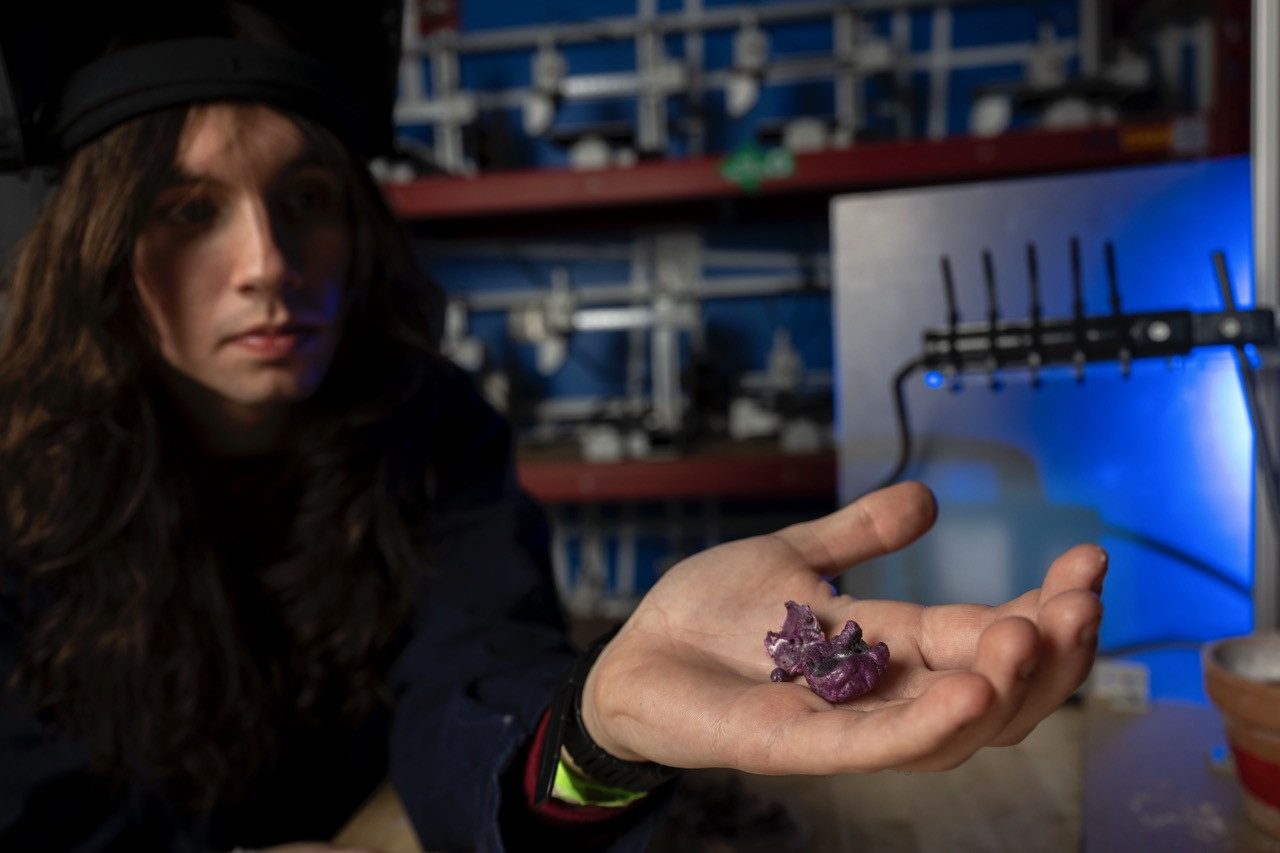
With two terracotta flowerpots, an arc welder, a pound of aluminum oxide, some chromium oxide, drill bits, and carbon electrodes, as well as safety protocols, Bender began creating his own gemstones. The arc welder was key, allowing him to produce enough heat to melt the aluminum oxide and chromium oxide, which crystallizes into a ruby.
Three years in, Bender’s pursuit of purer rubies persists. He’s fascinated by the chemistry and by the investigation it has inspired (he’s currently trying to generate hydrogen and oxygen to make a flame, which is how synthetic rubies are produced industrially). He’s also trying to find the best way to polish the gems. Bender wants, as he said, “to democratize the high-energy crystal space.”
Ultimately, he plans to produce a ruby pure enough to make a laser. The first laser, produced in 1960 by Theodore Maiman, used a synthetic ruby to generate the pulse of red light.
Journey to the ninth floor
During Bender’s second semester, he chose to pursue a degree in chemical engineering and minor in electrical engineering.
Emily Kerr, undergraduate academic advising manager for the Department of Chemical and Petroleum Engineering, sensed, upon meeting Bender, that he would thrive with new challenges. As she explained, “I started to reach out to professors in our department who could keep up with his insatiable curiosity.”
Last year, Bender and Kerr connected with James McKone, a professor of chemical engineering whose lab was conducting experimental electrochemistry. Bender joined the team on the ninth floor.
“The research involves developing and testing the reactions of electrochemical catalysts,” Bender said. “We’ve been testing ethanol-based films, which can be as small as two centimeters by two centimeters, and that need to be applied to a surface consistently. It’s a slow and messy process.”
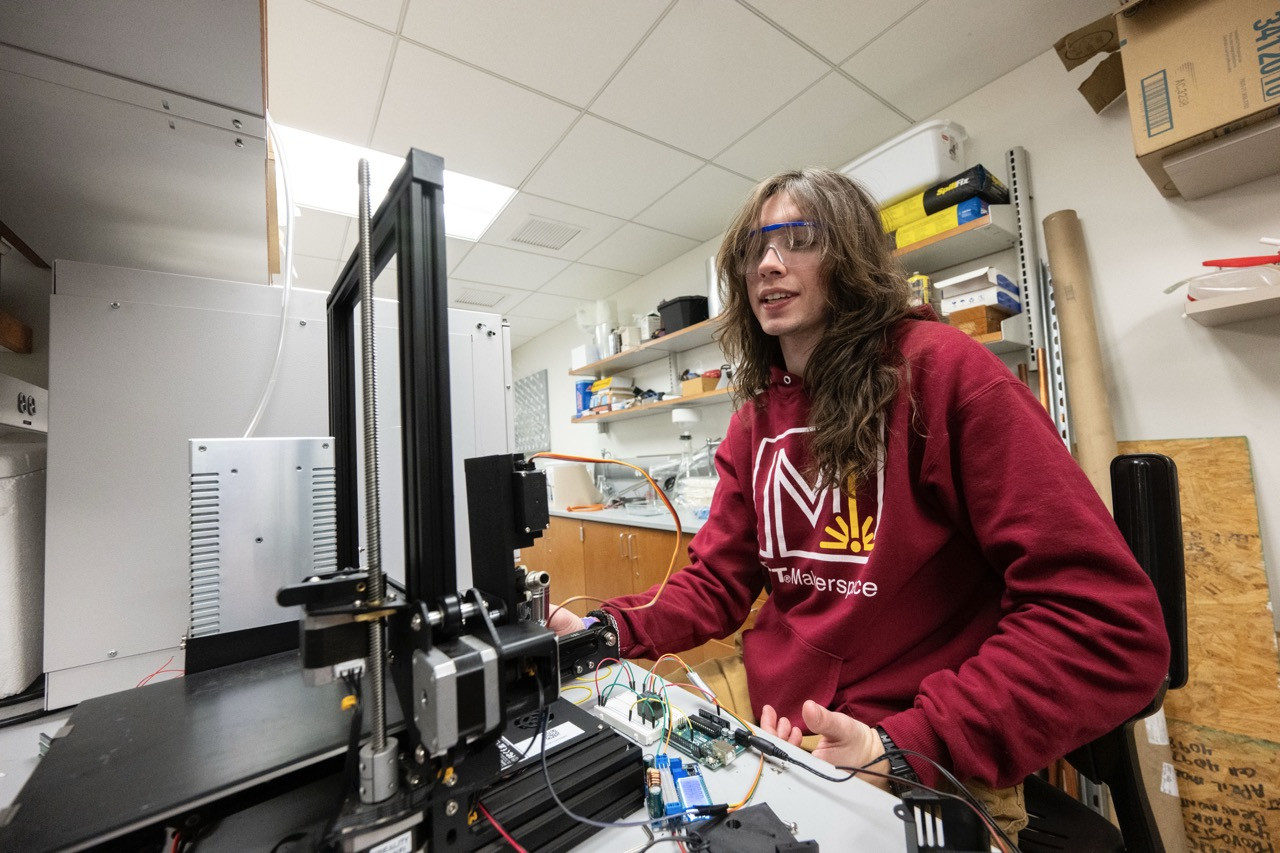
Bender believes that a reconfigured 3D printer might change that. Last year, he received a used 3D printer as a gift recognizing his third semester as a Makerspace mentor. However, he already owned a 3D printer and wondered what to do with this one.
“Last fall, I started thinking about the project I was working on in Dr. McKone’s lab and realized a 3D printer is just a controllable set of axes and motors. You can put anything on it that you want to move,” Bender said.
He began modifying the machine, attaching a spray gun in place of the extruder and securing it with rubber bands. He taught himself how to write G-code, which is used to program 3D printers. He needed to find a way to program the motor to pull the spray gun’s trigger at set intervals.
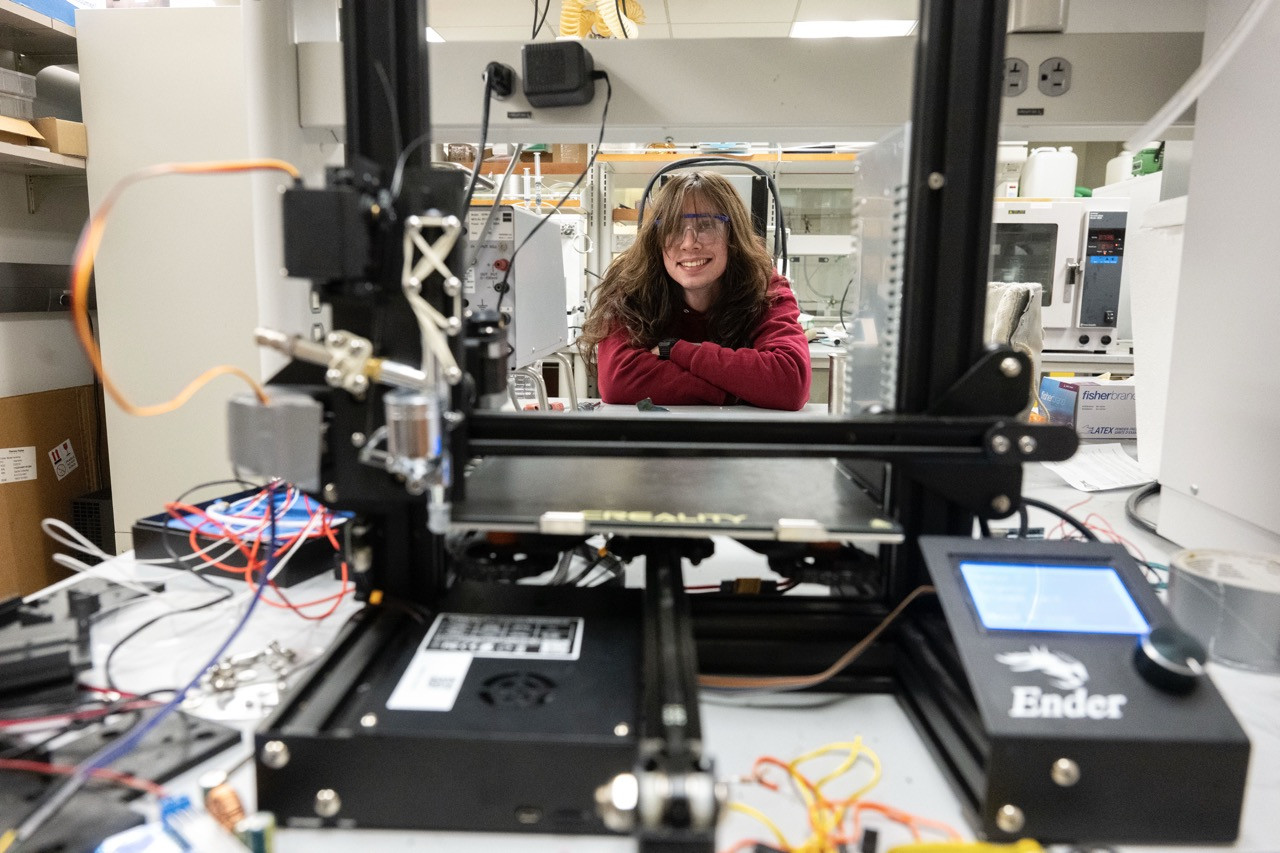
Bender relished the challenge of working with circuits and devising a way to control the voltage powering the fan and then the motor itself. Through hours of trial and error, he created a machine with an attachment that can move and spray the film precisely and consistently.
“This project has been an excellent foray into all these skills. I’ve created 13 prototypes of the mount itself,” Bender said.
Into Oakland
When Bender isn’t roaming Benedum Hall, he volunteers at the local music venue Haven, running the lights. Bender plays guitar and loves to attend live shows. Watching bands and designing the lights has inspired what may well be his next creation.
“I want to learn more about signals and systems, about music waveforms. And I want to turn that into a project,” Bender said. “I’d like to create a vest that you would wear while you’re playing. It’d take the signal from the guitar and change color as you play based on the frequency.”
While Bender still loves history, he’s never regretted choosing engineering. He’s grateful that his high school teachers and now his professors and his advisor have fueled his desire to experiment and to understand how things work.
“My favorite thing in the world is creating,” he said. “And since getting into chemical engineering, it’s just been an exponential cascade, upwards and out.”