
Facilities Overview
The Energy GRID Institute, established in 2016 by the Swanson School of Engineering as a global leader in building the clean and intelligent grid of the future, acts as the nexus for collaborative research, development, and demonstration that encourages economic growth and job creation and enhances Pitt’s incubator, start-up, and commercialization potential.
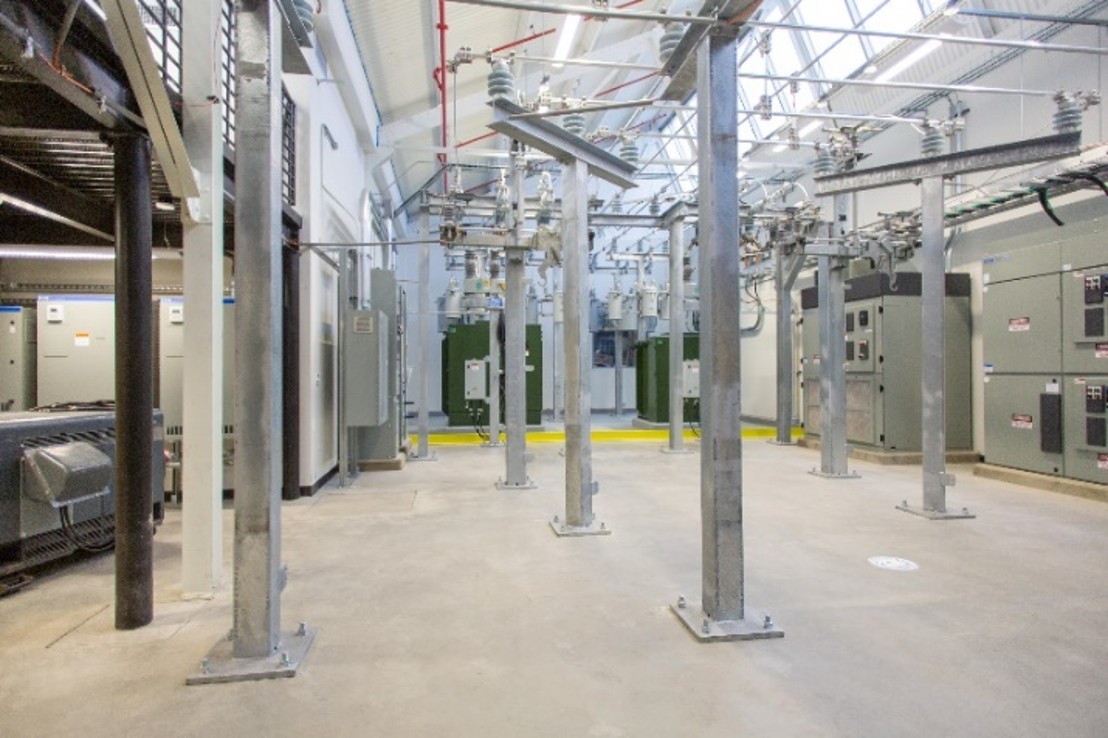
The University of Pittsburgh’s Energy GRID Institute, established to leverage public and private partnerships with state-of-the-art laboratories and facilities, is a comprehensive international solution center for the entire electric power industry, located in downtown Pittsburgh at the Energy Innovation Center. The laboratory was nationally benchmarked to create academia’s most advanced electric power utility scale research entity. The lab focuses on advancing modern power systems, integrating distributed generation sources into AC (15 kV, 4.16 kV, 480 V, 208 V) microgrids in order to demonstrate and study novel power products, as well as monitoring, control and protection systems.
Research at GRID encompasses AC and DC system studies, real-time digital simulation, performance analysis, forensic investigations and power electronic design, rapid prototyping, and testing up to 15 kV. The configurability of the system allows it to be fluidly changed to reflect a wide variety of grid layouts and conditions. The result is a facility that is uniquely capable of integrating education, training, demonstration, and testing, as well as research and development at the cutting edge of the power systems and power electronics industries, thus providing a drive towards greater collaboration with utilities, equipment vendors, and other universities.
Collaborative partnerships are integral to GRID’s success. The 20,000-square-foot buildout of laboratories and facilities signifies Pitt’s commitment to provide a flexible, largescale space for electric power and energy research, and to encourage partnerships with industry and the community.
Power Distribution Areas
- MV Grid Lab: Reconfigurable lab for traditional or microgrid projects. Designed using utility-grade distribution equipment.
- Test Lab: Isolated testing facility for safe testing of industry technologies.
- Infrastructure: Flexible power architecture capabilities – 13.8kV, 4.16kV, 480V, and 208V circuits.


Specialty Areas
- NEW Inverter Evaluation Facility: Sponsored by Duquesne Light Company
- SCADA Center: Automation, metering, and control for distribution network. Sponsored by Emerson
- Relaying and Controls: Protective relaying technologies, Phasor-measurement, and advanced control. Sponsored by Dominion
- HIL Center: Hardware-in-the-Loop capabilities – research and testing on industry equipment. Platforms include RTDS, PLECS RT Box, OPAL-RT, and Typhoon-HIL.
- Finite Element Analysis: Using ANSYS and Comsol for studying novel magnetic components.
Laboratory Ratings and Features
- Maximum AC Ratings at 15kV-ac, 5MVA
- Distributed Energy Resources and Load Integration including solar PV, wind power, etc.
- Energy Storage, Electric Vehicle to Grid
- Distribution Feeder Infrastructure
- Protective Relaying and Substation Automation
- Advanced Control and Communications, PMU
- FACTS and HVDC Control Systems
- Power Electronics Converters and other power technologies development, prototyping, and testing
- Technology testing and certification
- Specialized cage areas supplied by 480Vac and 208Vac service
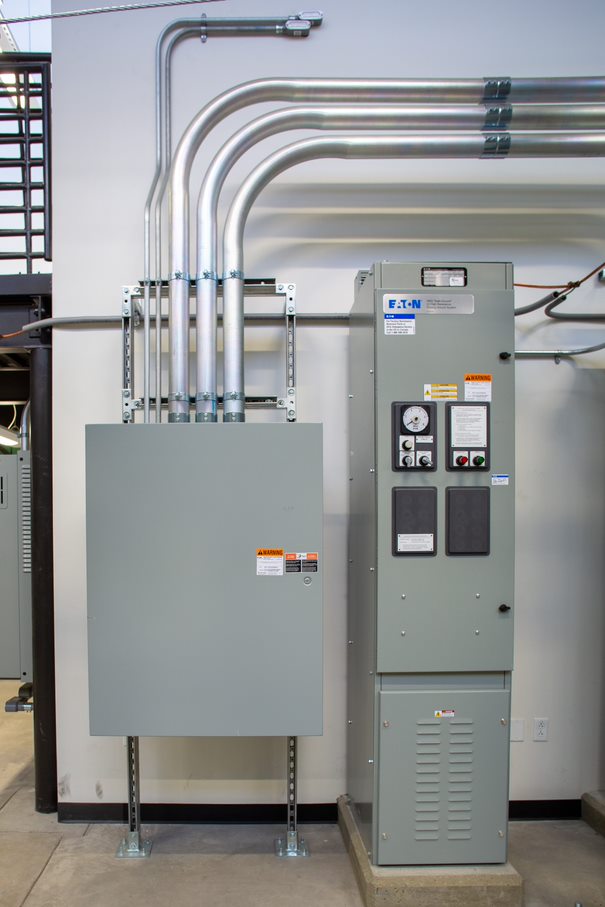
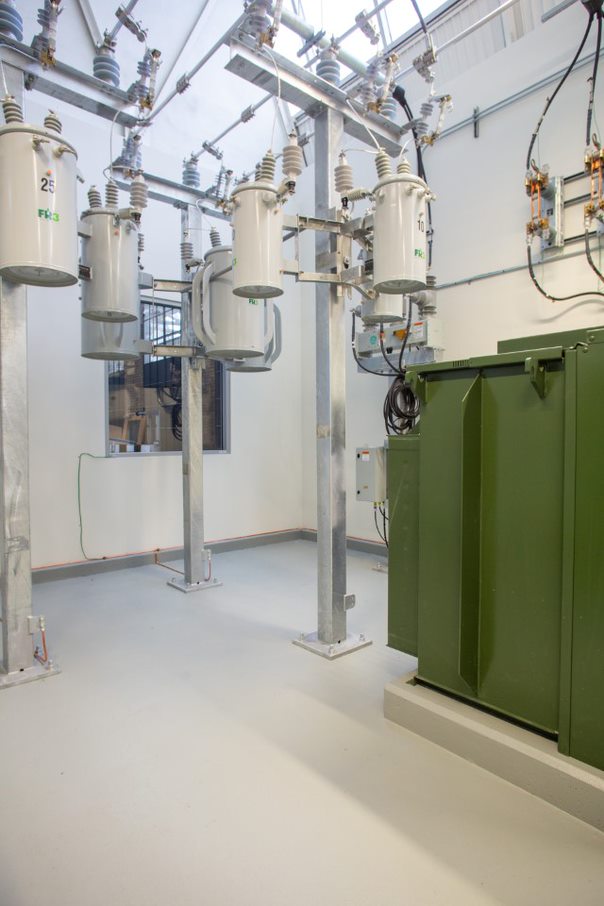


13.8 kV, 5 MVA Medium Voltage Test Facility: Design, Implementation and Lessons Learned
Hands-on, testing laboratories are fundamental to technical learning environments in universities. The need for modern equipment in these labs to support industry research and testing is often cost prohibitive and students and professors rely on a random collection of donated and often outdated equipment.
Electric Power Systems Lab

The new Electric Power Systems Lab at the University of Pittsburgh, sponsored in-kind by Eaton, is a multi-use facility for both research and educational activities. Located on the Swanson School of Engineering’s new Energy Floor in Benedum Hall, the lab provides opportunities for faculty and graduate students to perform advanced work in the areas of AC and DC micro-grid developments, smart grid technologies, power electronics devices and systems, renewable energy systems and integration, controls and communications, automation and relaying, distribution engineering, power quality, electrical safety, energy management, energy storage, and other emerging electric power technology areas.