
Setting out on Sabbatical

This story is the first in a three-part series that highlights the benefits and challenges of taking a sabbatical. In this article, University of Pittsburgh Swanson School of Engineering professors reflect on their experiences traveling overseas to research and collaborate with colleagues from different cultures and disciplines.
Across engineering fields, career stages, and personal circumstances, their stories share a common thread: overseas sabbaticals require planning, flexibility, and a willingness to step outside routines. They can be complicated.
Yet these professors all returned with new perspectives, new collaborations, reinvigorated research and educational programs, deeper cultural understanding, and insights that will shape their teaching and advising for years to come.
For professors at any career stage, especially at research universities, the reasons to delay or skip a sabbatical abound. There are labs to run, grants to manage, graduate students to advise, and papers to finish. Add to that the courses so carefully constructed and nurtured, families, service obligations, even inertia, and routines.
If the sabbatical happens to be abroad, the complexity only increases. How will it be funded? Is it realistic to uproot a family for months, or an entire year? What about language barriers?
Suddenly, an amazing opportunity of taking a semester or an entire year to recharge, uncover new research, rekindle collaborations, conduct new experiments, write, and learn can feel like a burden.
Yet for those who do take a sabbatical, the experience is deeply rewarding if not life changing. While overseas sabbaticals are complicated, they offer a unique opportunity to forge lasting relationships, engage across cultures, and reimagine one’s research and teaching.

“You might say I’m resistant to change.”
Harvey Borovetz, Distinguished Professor of Bioengineering, worked at Pitt for 38 years before he took a sabbatical. But when he did, it created connections that continue to flourish to this day and provide unique opportunities for students at Pitt and at Braude College of Engineering in Karmiel, Israel.
In November 2013, after stepping down as department chair, Borovetz and his wife traveled to Israel and visited the college. The following semester, he took a four-month sabbatical and lived in Karmiel, where he taught a course and developed professional relationships that have endured through a global pandemic and the Israel-Hamas War.
For five years after that first visit, Borovetz returned each year to teach. Since Covid and the war, he’s continued annually teaching remotely. Students in the Swanson School have visited Braude for a summer research experience, and their students have come to Pitt, likewise for a research experience. The exchanges are rooted in the trust and familiarity built during his sabbatical.
“For me, the people and relationships matter most,” said Borovetz. “The sabbatical didn’t advance my research per se, but I’ve grown so much as a teacher. Most of my students in Israel speak English as their second language. They’ve served in the military before attending college, and they come to class with a different set of experiences than students I teach at Pitt.
“I’ve had the opportunity to live like a citizen there,” he added. “I’ve been invited into the homes of families whose students I teach and faculty colleagues who I’ve met and have become good friends with over the years. And the relationship between Pitt and Braude continues today because of these strong connections.”
“It’s easy not to do this,” Borovetz said, “but it’s an amazing experience.”
“It jump-started my work”
Like Borovetz, Bopaya Bidanda, Ernest Roth Professor of Industrial Engineering, had never taken a sabbatical. Between chairing the department, teaching, researching, and traveling abroad to forge transdisciplinary collaborations, the time never seemed right.
In the early 2020s, Bidanda was researching “frugal engineering,” an approach rooted in innovation under constrained resources, and wanted to see it in action. For Bidanda, that meant returning to his old home.
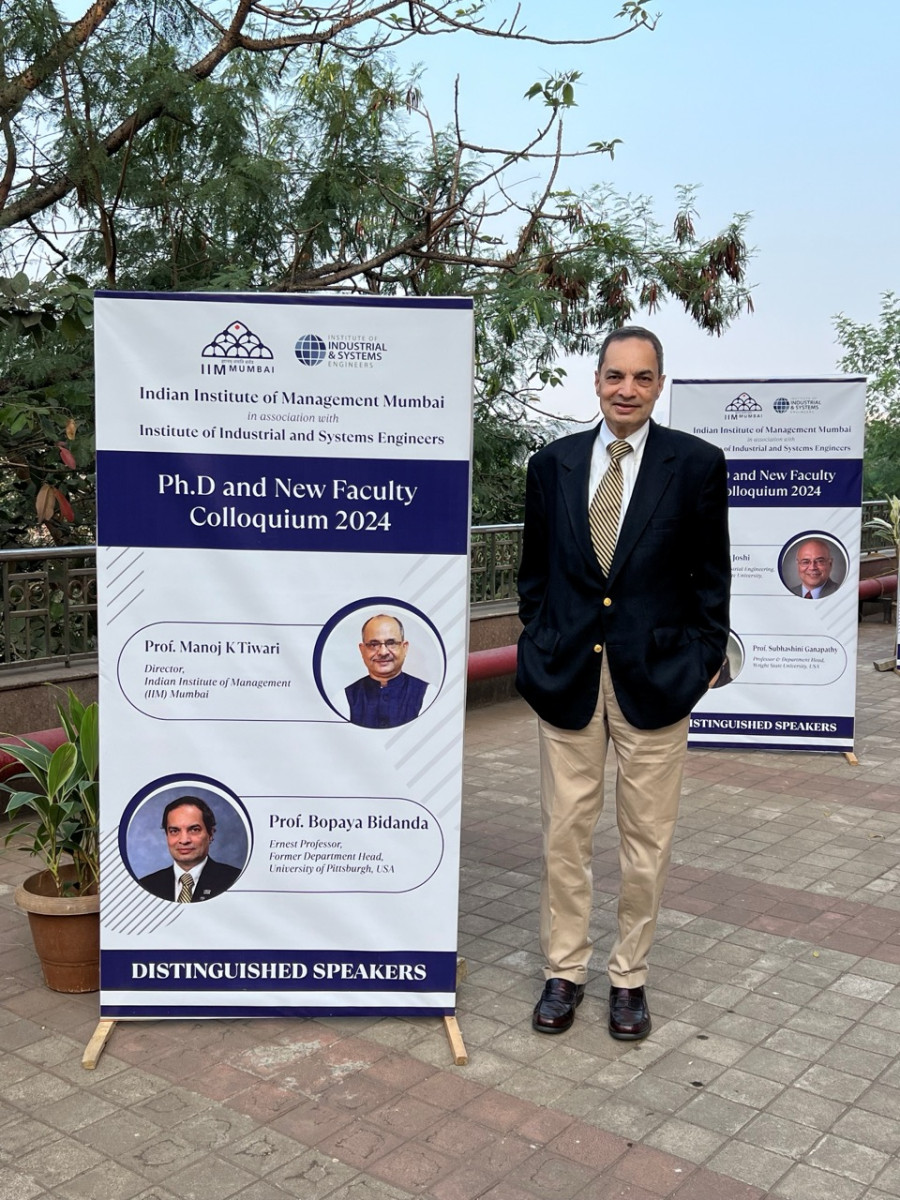
In 2023, he applied for and received a Fulbright-Nehru Award to conduct research and promote industrial engineering excellence in Mumbai, India.
“I spent four months there building networks,” said Bidanda. “I organized a PhD colloquium with about 85 students and faculty from across India and assembled a group of scholars from around the world to help new faculty and PhD students develop global research networks.”
“Working in India involves navigating cultural dynamics alongside research. There are incredibly innovative aspects as well as bureaucratic ones,” he added. “Even though I grew up in India, returning to work there after many years was an adjustment. I felt like I was rediscovering an entirely new India.”
This impact of the sabbatical continues to ripple outward, for faculty and students in India, and for Bidanda. The colloquium was so successful that the Fulbright Commission of Sri Lanka has invited him to conduct a similar program in 2026, extending the work he started while in Mumbai.

“There isn’t just one ‘right’ way.”
When Lance Davidson, William Kepler Whiteford Professor of Bioengineering, began studying epithelial tissues in frogs, he needed new computational models. A colleague overseas, in the Dutch town of Leiden, had developed a model for plant epithelia, and an opportunity to collaborate set in motion a long-overdue sabbatical.
With funding from the Dutch Research Council, Davidson spent January through May 2019 at Leiden University, the oldest surviving university in the Netherlands, embedding himself in a lab of computational biologists.
“I stayed in a house across a canal from one of the oldest botanical gardens in the world,” Davidson said. “I biked everywhere, brought my bike on trains, and connected with colleagues across Europe.”
Davidson participated in PhD committees, exams, and mentoring, gaining a unique window into science and education in the Netherlands. “The Dutch approach differs from ours, but the quality is outstanding,” he said. “It reinforced the idea that there isn’t just one ‘right’ way to train students or conduct research.”
The experience was not without challenges. Davidson’s wife couldn’t join him, and he still ran his lab at Pitt, still advised his PhD students. “It was difficult, and the time difference made for many late nights.”
Yet the experience fueled new research and resulted in a publication with his Dutch collaborator. Today, Davidson is beginning to plan his next sabbatical.

“It was great to have them here.”
From August to December 2025, Nathan Youngblood, associate professor in the Department of Electrical and Computer Engineering, lived in Heidelberg, Germany, with his wife and two sons. At Heidelberg University, he collaborated with renowned physicist Wolfram Pernice and researchers from across Europe to advance work in optical computing, an emerging field that uses light to process information faster and more efficiently.
“Advancing this technology requires collaboration across disciplines,” Youngblood said. “Many of my European collaborators work in physics, electronics, or materials science. Being able to connect in person, visit their labs, and meet their collaborators was invaluable.”
Bringing his family overseas was logistically challenging, but meaningful. “It was great to have them here,” he said. His sons, ages four and six, learned some German, and the family traveled throughout Europe.
At the same time, fully disconnecting proved difficult. Youngblood continued to direct his Youngblood Photonics Lab at Pitt and advise his large research group. “I wish I had unplugged a bit more,” he said. “Maintaining contact from overseas took up a lot of time.”

“The plan was to start writing a book.”
Aleksandar Stevanovic, associate professor of civil engineering, taught for 18 years before he took a sabbatical. “I never felt it was the right time,” he said. “I was always too busy.”
Last year, Stevanovic, a traffic engineer who researches ways to improve traffic in urban environments, developed a plan to visit colleagues and lay the groundwork for writing a book. His sabbatical was set. But then he received two awards: a Fulbright to spend ten months at the University of Montenegro and a visiting professor scholarship to visit the Technical University of Munich, in Germany.

Instead of planning a book, Stevanovic flew to Podgorica, Montenegro, a city with about 50 traffic signals total, where he has collaborated with faculty and city officials, delivered lectures, and helped the university develop its traffic engineering studies. He’s also been analyzing the city’s infrastructure and traffic to help improve it.
In Germany, he has collaborated with researchers and his own PhD students to explore the future of transportation in a vastly different context.
While much busier than he’d anticipated, the experience has been hugely illuminating. “I’m bringing a new perspective to these places,” Stevanovic said, “but I’m also learning things that will be useful for my future research. It’s going to trickle down to my students.”

“We called it Disneyland for academics.”
Anna Balazs, Distinguished Professor in the Department of Chemical and Petroleum Engineering and the John A. Swanson Chair of Engineering, traveled to Oxford University in 2001 at the encouragement of a scientist she knew there. Although Balazs didn’t know her that well at the time, the decision would alter the trajectory of her research.
For Balazs, Oxford was a magical place. Each day at 11:00 a.m., the entire department congregated for teatime. “You were always talking to someone interesting,” Balazs said. “There was just a level of intensity and joy about knowledge.”
During her first sabbatical in England, she brought a postdoctoral researcher. The two would stay in the lab late into the evening. “We were working hard and we’d stop and get kebabs on the way home.”
Balazs investigates polymetric materials and how they interact on surfaces. From her collaborator at Oxford, physicist Julia Yeomans, she learned a new technique that has been invaluable.
“It's called the lattice Boltzmann method, which is used for numerically solving the Navier-Stokes equation. We extended it so that it interacts with soft materials, so you can get the interaction between a soft material and a flowing fluid,” Balazs said. “It's a backbone of what we do today.”
Seven years later, this time with her husband, a computer scientist, she returned. “I think for both of us,” Balazs said, “it changed our lives.”
Beyond the research and opportunities to meet scholars so passionate about their work, she formed a lasting connection. “I made a new friend there, who’s a friend for life, and who gave me a goddaughter.
“Those two years at Oxford were some of the best years of my life,” Balazs added. “They were life changing.”

“Despite the daunting logistics, everything worked out.”
John Keith, associate professor and RK Mellon Faculty Fellow in Chemical & Petroleum Engineering, had been, as he described, “an old-school computational chemist.” Although researchers were increasingly incorporating machine learning into the field, he remained cautiously skeptical.
In 2019, having just received tenure, and with two young sons and a third child on the way, Keith faced a complicated puzzle: funding a sabbatical in Luxembourg with his family for an entire year. In the end, he managed to get the pieces to fit.
Keith joined the research group of Alexandre Tkatchenko at the University of Luxembourg, moving his family abroad just months before Covid upended daily life worldwide. In an unexpected twist, the family even appeared on House Hunters International.
“I joined a top research group,” Keith said. “They had reconciled rigorous computational chemistry with machine learning in a way I respected. It was serious, high-quality science, and I built a strong network there.”
The work culminated in a paper in Chemical Reviews, with Keith as first author.
“I returned supercharged with ideas,” Keith said. “The sabbatical was pivotal. It gave me a foundation for future collaborations, ready to fully embrace machine learning in my research.”
Navigating funding, schooling, housing, and a global pandemic in a foreign country was daunting, but for Keith, like his Pitt colleagues who also ventured overseas on their sabbaticals, the payoff was profound.