
Programming Matter: A Winning Vision for Protein‑Based Manufacturing
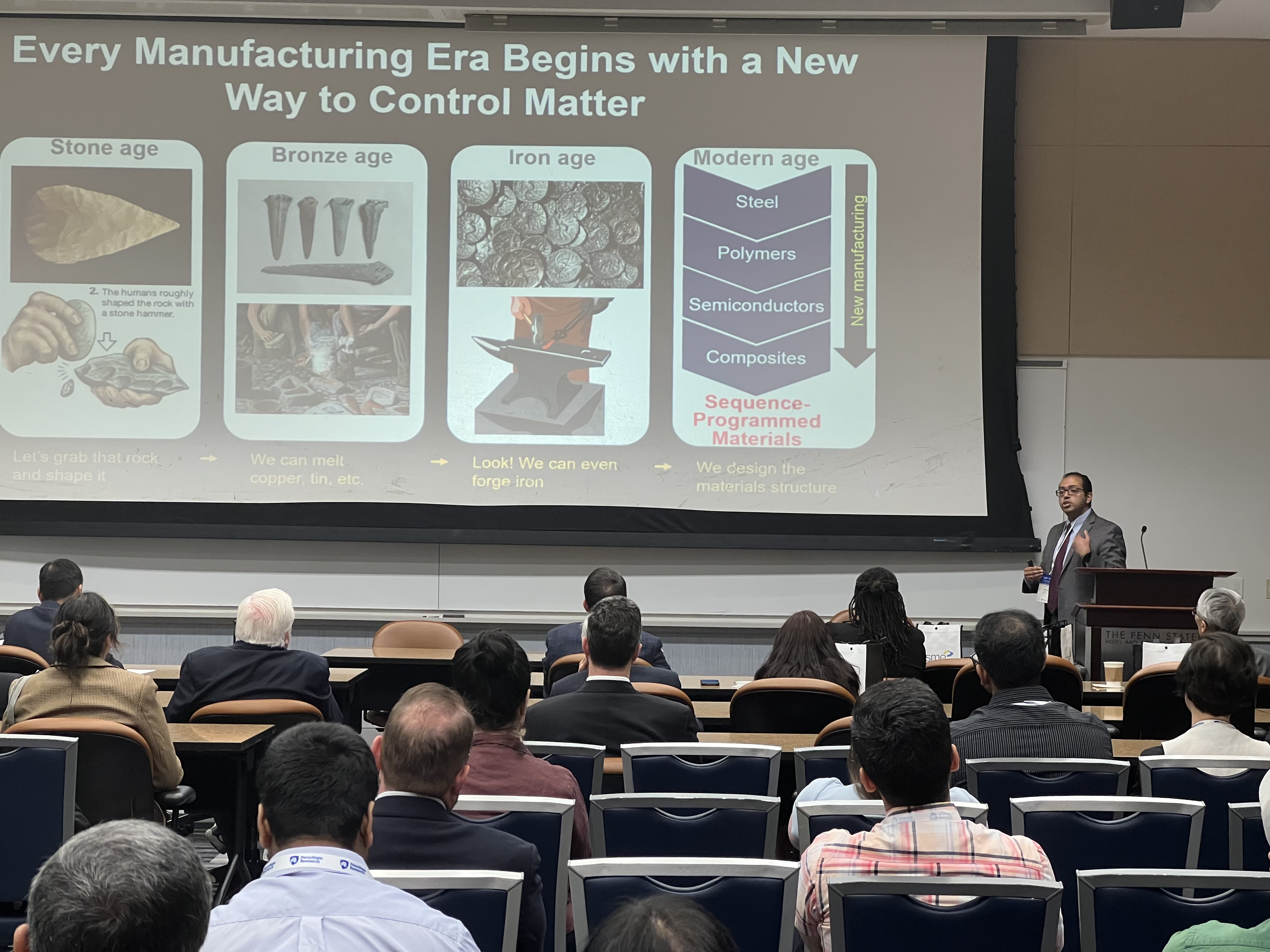
Image above: Bedewy presents his winning presentation at the NSF Manufacturing Blue Sky Competition.
A concept for programming materials from the inside out earned University of Pittsburgh researcher Mostafa Bedewy and collaborators the top honor in the 2026 NSF Manufacturing Blue Sky Competition earlier this summer.
Bedewy, associate professor of mechanical engineering and materials science in Pitt’s Swanson School of Engineering, developed Protein-Based Manufacturing, or ProMan, with Won Min Park, associate professor of chemical engineering at Kansas State University, and Meng Wang, associate professor of civil and environmental engineering at the University of Houston. Their presentation, “Protein-Based Manufacturing (ProMan): Programming Matter through Molecular Information,” was selected to receive the SME’s David Dornfeld Manufacturing Vision Award.
People have made silk textiles for thousands of years by harvesting, cleaning, weaving, dyeing and shaping the material into products. But the silkworm produces the fiber’s underlying architecture: The protein’s amino acid sequence directs how it folds and assembles into a material that is both tough and flexible.
The ProMan vision would give engineers more direct control over molecular sequence and how proteins fold and assemble during processing.
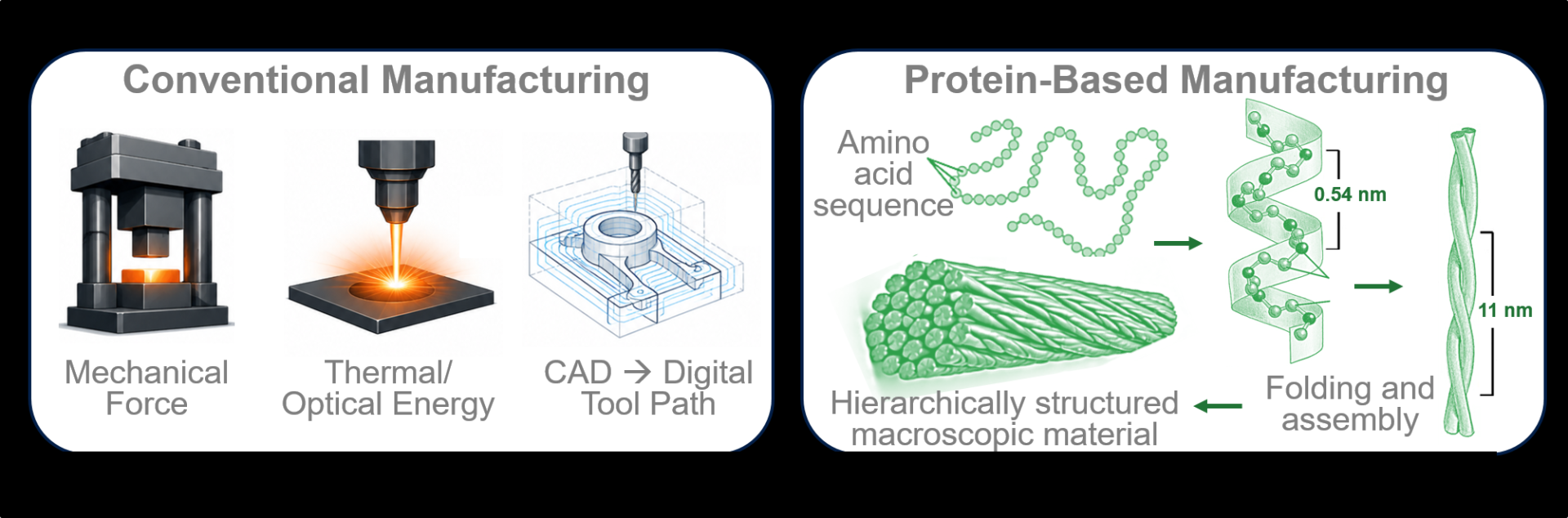
“For thousands of years, manufacturing has been about imposing shape on matter using force, heat, tools, molds, and more recently, digital toolpaths,” Bedewy said. “It’s time to think about the next major shift in manufacturing with molecular information as a new control knob.”
In materials science, engineers often describe how processing creates structure, which produces properties and ultimately determines performance. ProMan would add sequence at the beginning of that chain. A designed sequence could guide how a protein folds, binds and assembles as it is processed.
“If we can design the amino-acid sequence, and then control how that sequence folds and assembles during processing, we gain a fundamentally new way to control material structure and function,” Bedewy said.
Realizing the ProMan vision requires more interdisciplinary collaborations and advances in protein sequence design, assembly control, scalable production, purification, inline measurement and quality control. The team also envisions proteins serving as materials themselves or as templates for metals, oxides, semiconductors, catalysts and devices.
“Pittsburgh has a long history of innovation in manufacturing, from steelmaking to advanced materials and modern manufacturing technologies,” said William (Buddy) Clark, Interim Chair of the Department of Mechanical Engineering and Materials Science. “It is fitting that an emerging vision for protein-based manufacturing is being advanced here as well. This is exactly the kind of forward-looking, multidisciplinary thinking our faculty excel at, connecting materials science, manufacturing, biology, and engineering to imagine what the future of the field could become.”
Bedewy’s research spans advanced manufacturing, nanomaterials and biointerfaces, including earlier work on flexible, biodegradable materials made from silk proteins and carbon nanotubes. Park develops self-assembling protein nanomaterials, while Wang uses protein design and bionanotechnology to address environmental challenges.
Supported by the National Science Foundation and organized through SME, the Blue Sky Competition seeks large-scale ideas that could shape U.S. manufacturing research and education. Entries are judged on scope, interdisciplinary reach, presentation quality and potential impact. Bedewy presented the team’s vision on June 16 at a joint gathering of the 54th NAMRI/SME North American Manufacturing Research Conference and the 2026 ASME International Manufacturing Science and Engineering Conference in State College, Pennsylvania. He will be recognized again during the SME Fall Gala on October 20 in Las Vegas.
Bedewy also serves as graduate program coordinator for materials science and engineering and holds secondary appointments in bioengineering, chemical and petroleum engineering, and industrial engineering. He leads the NanoProduct Lab, which studies advanced manufacturing across nanoscience, biotechnology and materials engineering.