
Listening for Trouble
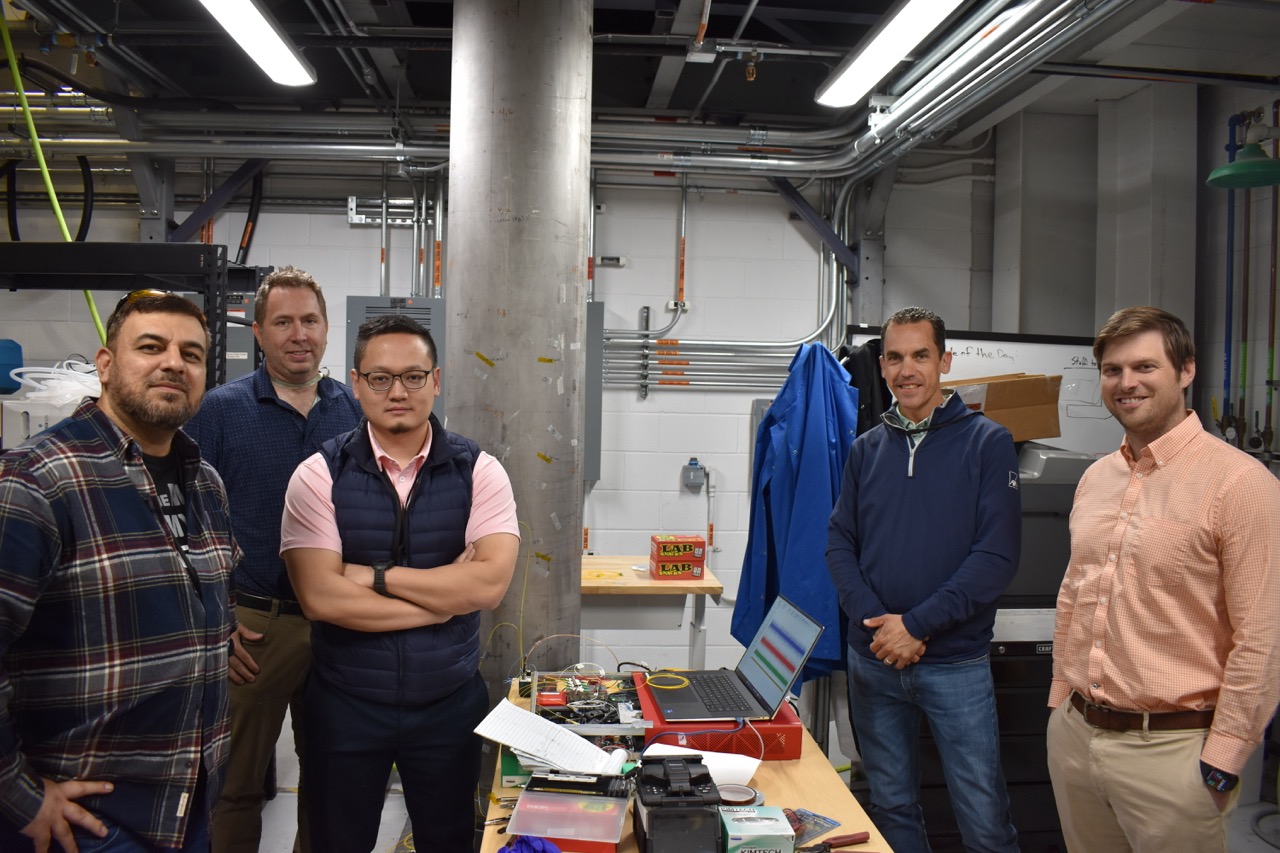
Researchers at the University of Pittsburgh Swanson School of Engineering have partnered with Pittsburgh startup Sensible Photonics, co-founded by Pitt professor Paul Ohodnicki, to develop a fiber-optic ultrasonic acoustic-sensing system that can detect corrosion and cracking in steel nuclear fuel storage canisters. From September 8 to 11, the Pitt team of Ohodnicki, Khurram Naeem, and Yang-Duan Su conducted field testing of an early concept of the technology at the Idaho National Laboratory (INL), in Idaho Falls, Idaho. The tests demonstrated the feasibility of the system, which has the potential to keep nuclear energy plants and surrounding communities safer.
“People tend to think about fiber-optics as a way to produce faster internet speeds, but it can be used to continuously monitor everything from bridges to batteries to nuclear waste,” said Naeem, technical lead on the demonstrations and a research assistant professor in mechanical engineering and materials science. “We have developed and now demonstrated a system that can detect signals above 100 kilohertz, which can be retrofitted onto casks used to hold spent nuclear fuel. Most conventional counterpart systems have a 20-kilohertz capability.”
At nuclear reactor sites, spent fuel is cooled in water and then sealed into steel canisters, which are encased in concrete casks that can remain onsite for decades. Even after cooling, spent fuel generates heat, so the casks include vents.
“Many nuclear energy plants are near coasts, and these vents can let in salty air that can corrode the steel, creating cracks that could compromise the canister’s integrity,” said Su (PhD MEMS ’26), a postdoctoral research associate.
The fiber-optic sensing was developed to monitor the sound produced if a steel canister began corroding and cracking, alerting officials before a dangerous accident occurred.
“At the INL, we deployed the fibers outside a mock canister using different configurations to demonstrate the sensors could detect different magnitudes of acoustic vibration, validating the sensitivity of the sensor,” said Su.
“Through a series of pencil-lead-break tests, we showed that the technology could detect the sound and find the source,” Naeem said. These standard tests provide a way to generate a repeatable sound and are used within the industry for benchmarking.
The team also tested methods of adhesion that could secure the sensors on the casks for years and withstand high-temperature, high-radiation conditions.
“Beyond the testing, we collaborated with scientists from the INL, the Oak Ridge National Laboratory, and the Pacific Northwest National Laboratory as well as with industry researchers,” said Su. “The opportunity to share ideas will guide the next phase of this project.”
“Khurram and Yang did tremendous work advancing this technology and successfully deploying it during the field test,” said Ohodnicki, professor of mechanical engineering and materials science at the Swanson School, R.K. Mellon Faculty Fellow in Energy, and director of the University of Pittsburgh Center for Energy. “We are grateful for the opportunity to partner with the INL and other national labs and for the Department of Energy funding and support of Sensible Photonics that made this project possible.”
The field test marked the end of Phase I of the project, which was funded through a Small Business Technology Transfer (STTR) grant to Sensible Photonics based upon technology initiated under the U.S. Department of Energy’s Nuclear Energy University Program (NEUP). Recent demonstrations were pursued with additional financial support provided through a competitive selection process by the U.S. Department of Energy’s Office of Nuclear Energy.
The Pitt team now hopes to secure additional funding to continue the project’s momentum to date, to support further testing for robustness and stability and developing a mature system for commercialization. If successful, the system could one day listen for trouble at nuclear energy plants across the country.