
University of Pittsburgh Receives $1.62 Million From Appalachian Regional Commission to Launch the Pittsburgh Laser Engine
“Building a workforce equipped with the skills needed for emerging industries is essential to creating a path to lasting economic vitality throughout Appalachia,” said ARC Federal Co-Chair Gayle Manchin.
Learn more at www.arc.gov/POWER.
The University of Pittsburgh has been awarded $1.62 million by the Appalachian Regional Commission (ARC) to establish the Pittsburgh Laser Engine, a training and manufacturing innovation center that will prepare displaced coal workers for advanced laser-processing careers and train union electricians in fiber-optic sensing for AI data centers, power systems and other critical infrastructure.
The award comes through ARC's POWER (Partnerships for Opportunity and Workforce and Economic Revitalization) Initiative, which directs federal resources to help Appalachian coal communities expand economic opportunities by creating high-quality, in-demand jobs, attracting new private investment and providing comprehensive workforce services and skills training. Pitt's Swanson School of Engineering will lead the three-year project with Robert Morris University, working across Allegheny, Fayette, Greene, Washington and Westmoreland counties. ARC classifies Fayette County as at-risk and the other four as transitional.
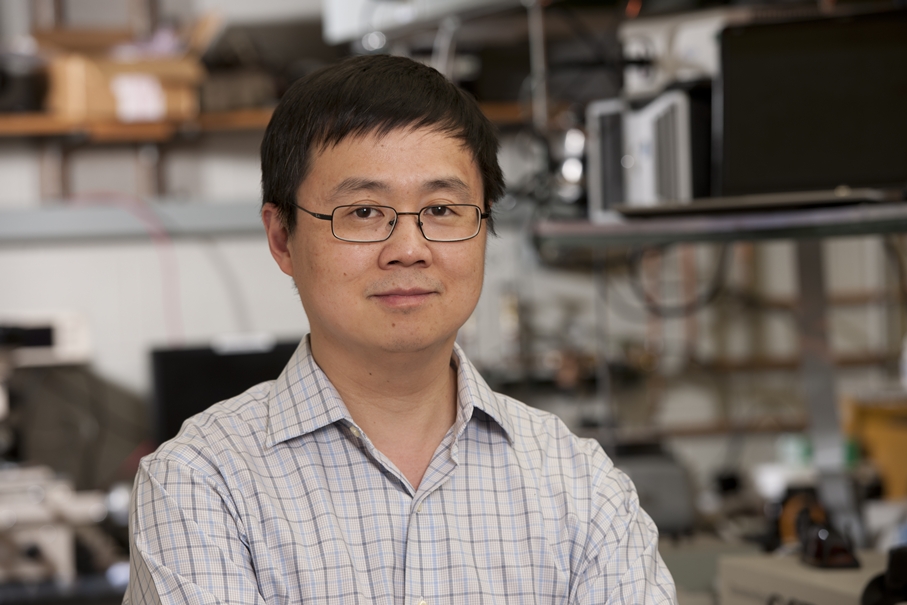
“Southwestern Pennsylvania built its economy on making things, and lasers are increasingly part of how those things are made,” said Kevin P. Chen, the Paul E. Lego Chair Professor of Electrical and Computer Engineering at the Swanson School and principal investigator. “Experienced workers bring valuable skills in safety, problem-solving and operating in demanding environments. This project builds on that experience with the laser-processing skills needed for new opportunities in advanced manufacturing.”
Greater Pittsburgh has been a manufacturing powerhouse for the United States for generations, and today our region is home to world-class capabilities across the laser and photonics ecosystem, from Coherent in laser and photonics technologies, to Aerotech in precision motion control and automation, to advanced optical engineering and simulation technologies,” Chen said. “We believe Pittsburgh has the ingredients to become a national hub for laser and photonics manufacturing and the high-paying skilled jobs that come with it. The Pittsburgh Laser Engine is designed to bring these strengths together by connecting industry, universities, technology and our region’s experienced manufacturing workforce to create the next generation of advanced manufacturing opportunities.
At workforce development fronts, two programs anchor the work: Advanced Laser Processing is a 10-week hands-on course to be offered twice a year at the United Mine Workers of America Career Center in Greene County. Participants will learn to operate high-power fiber and pulsed lasers, program motion systems in G-code and apply laser welding, surface treatment and precision drilling, then finish with a two-week capstone on industry equipment.
Fiber Optic Sensing, developed with the International Brotherhood of Electrical Workers training school, will prepare electricians to install and calibrate the distributed fiber sensors that monitor temperature, detect fires and keep AI data centers and power systems running. Both programs award a certificate of completion, connect graduates to hiring partners and require no college degree to enter. Together, the programs aim to train at least 320 participants – 120 in Advanced Laser Processing and 200 in Fiber Optic Sensing.
“Building a workforce equipped with the skills needed for emerging industries is essential to creating a path to lasting economic vitality throughout Appalachia,” said ARC Federal Co-Chair Gayle Manchin. “Through our POWER initiative, ARC is proud to support the University of Pittsburgh as it connects workers with the training needed to pursue high-quality careers in growing fields. Not only will the Pittsburgh Laser Engine help strengthen the region’s workforce, but it will also prepare communities across Southwestern Pennsylvania to compete in an evolving economy.”
These two signature training programs exemplify the Swanson School’s approach to workforce education: bringing cutting-edge university research and emerging technologies directly into hands-on vocational training. By combining the School’s expertise in laser processing, photonics, AI, and fiber-optic sensing with the practical training infrastructure and experience of our workforce partners, the programs are designed to create accessible pathways into high-skilled, high-paying advanced careers while building the technical workforce needed to strengthen Southwestern Pennsylvania’s emerging laser and photonics ecosystem and support the region’s growing ambitions in AI and data center infrastructure.
Beyond workforce training, the project will establish a laser engineering center that gives regional companies access to advanced equipment and technical expertise that would otherwise be difficult or costly to obtain. Pitt and Robert Morris will combine their existing laser facilities with new equipment, including a femtosecond laser system capable of nanometer-scale precision and an ultra-high vacuum processing facility for cryogenic and quantum work, then open the combined operation to outside users as what the team calls a Laser Maker Space. The goal is to serve 40 regional businesses, help at least 20 post measurable gains in productivity or competitiveness, and help participating companies collectively secure more than $3 million in federal and private investment by the project's close in April 2029.
Pittsburgh Laser Engine aims to become the nation’s preeminent center for laser innovation, advancing cutting-edge laser technologies in stand-off laser sensing, fabrication of radiation-hardened distributed optical sensors, target manufacturing for inertial confinement fusion, and advanced diamond processing. The Center will also support regional businesses in developing advanced manufacturing capabilities that address national priorities, including shipbuilding, energy security, critical mineral extraction, and high-performance computing.
To guide this effort, the Center is collaborating with distinguished leaders in technical director and board roles, including Dr. Yongfeng Lu, former president of the Laser Institute of America; and Dr. Ming-Jun Li, a Corning Corporate Fellow and National Inventors Hall of Fame inductee.
“Regional manufacturers need access to advanced equipment and technical expertise, while workers need pathways into fields such as laser processing and fiber-optic sensing; the Pittsburgh Laser Engine is designed to address both needs at the same time,” said U. S. Steel Dean Michele V. Manuel.
The region has absorbed decades of contraction in coal mining and coal-fired generation. Between 2010 and 2020, Greene County's population fell 7.1 percent and Westmoreland County's fell 2.9 percent, while the nation grew 7.4 percent. Southwestern Pennsylvania also loses roughly half of its college graduates, even as employers in photonics and advanced manufacturing report they cannot fill skilled technical openings. The U.S. laser processing market is worth $5.1 billion and growing about 8.5 percent a year, and the photonics sector is projected to need 42,000 new technicians nationally by 2030.
Nineteen organizations submitted letters of support for the project, including the Naval Nuclear Laboratory, the National Energy Technology Laboratory, AIM Photonics, the Penn State Electro-Optics Center, Coherent, Corning, Aerotech, ANSYS, Lake Shore Cryotronics, MECCO, TRUMPF and Thorlabs, along with startups Laser Universal, AiMiLi, Z9 Machining and Dvorchak Enterprises and the City of Pittsburgh. Separately, 17 corporate partners have committed more than $2.2 million in equipment donations, according to Chen, and the Engineering Education Research Center at Pitt will evaluate learning outcomes for both training programs.
###
About the Appalachian Regional Commission (ARC)
The Appalachian Regional Commission is an economic development entity of the federal government and 13 state governments focusing on 423 counties across the Appalachian Region. ARC's mission is to invest and partner to strengthen economic development in Appalachia to help the region reach its full economic potential.
More about Kevin Chen
Kevin P. Chen is the Paul E. Lego Chair Professor of Electrical and Computer Engineering at the University of Pittsburgh Swanson School of Engineering and a jointly appointed scientist at Idaho National Laboratory. His group is known in industry for reel-to-reel fabrication of distributed fiber sensors and for turn-key sensor instrumentation used in advanced energy systems. He has published more than 350 peer-reviewed papers, holds more than a dozen patents, has served as principal investigator on more than $18 million in federal, state and industry-sponsored research, and won a 2017 Carnegie Science Award for his work in fiber optical sensing. Co-principal investigator Benjamin Campbell, professor of engineering at Robert Morris University, won a 2022 Carnegie Science Award for exemplary educational and corporate collaboration and began his career at the Penn State Electro-Optics Center. Robert Morris operates the region's only ABET-accredited manufacturing engineering program.