
Advancing Understanding and Modeling of Deep Uncertainty in Nuclear Power Risk Assessment
Collaborator: Oak Ridge National Laboratory
Sponsor: ORAU Ralph E. Powe Junior Faculty Enhancement Award (July 2026 – June 2027)
Background & Objectives
Existing probabilistic methods provide a solid foundation for quantifying aleatory uncertainty and 'tangible' epistemic uncertainty, particularly when relevant empirical data exist or when the scientific community and industry practitioners have reached consensus on how to quantify them. These methods, however, can produce misleading results under conditions of deep uncertainty, where analysts do not know or cannot agree on appropriate conceptual models, probability distributions, or value functions for weighing outcomes. These conditions can arise for different reasons, for instance, when analyzing extreme events with very low likelihood but high impact (e.g., extreme external hazards) and assessing novel technologies with limited or no prior operating-experience data.
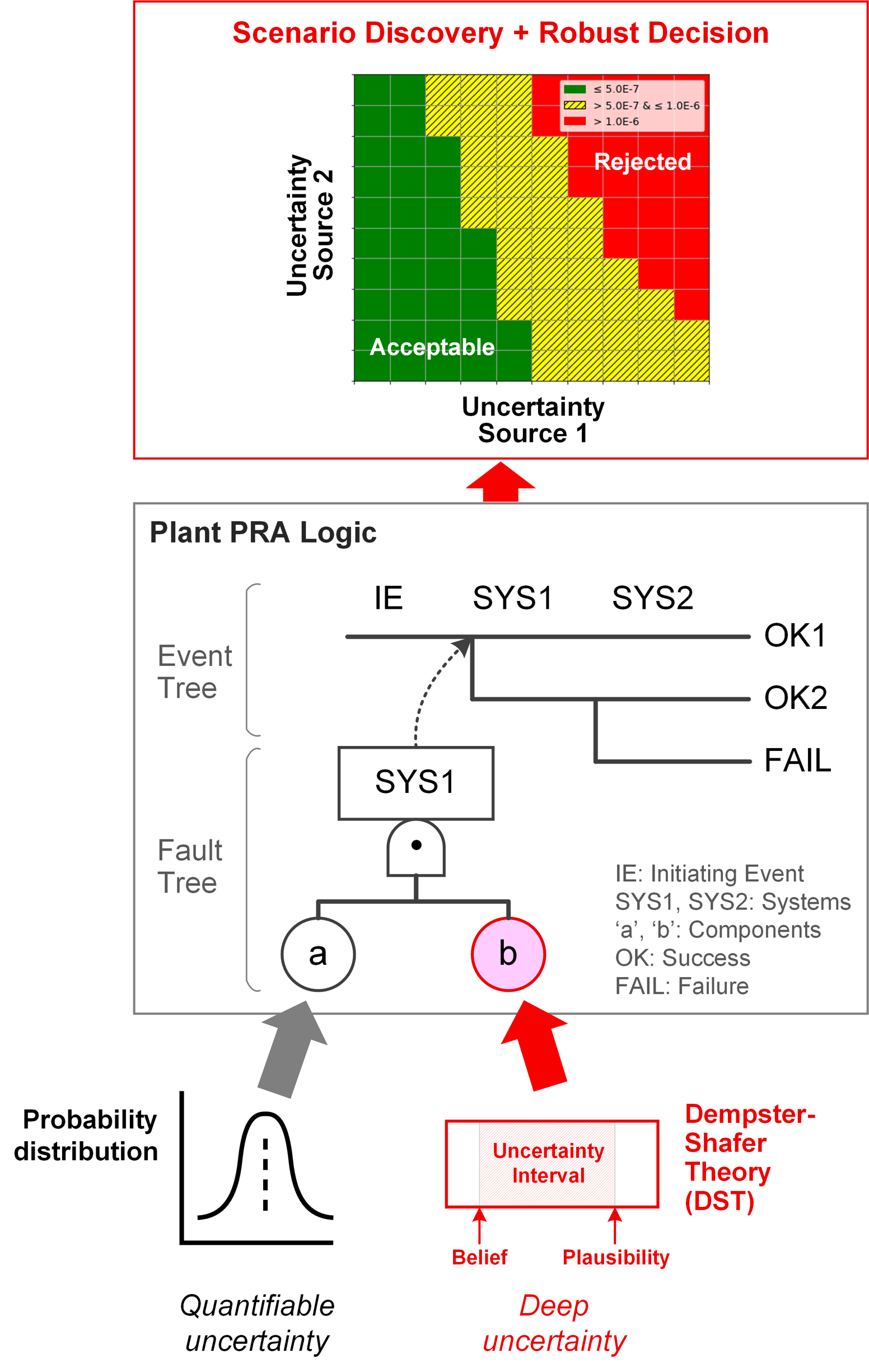
This research develops a methodological foundation and computational platform for explicitly analyzing deep uncertainty in the risk assessment of nuclear power systems. The proposed approach enables a deeper understanding and more effective modeling of the most challenging forms of epistemic uncertainty, namely model uncertainty and completeness uncertainty, which often resist quantification through conventional probability theory. Rather than replacing existing probabilistic risk assessment (PRA) methods, this proposed framework aims to extend them: when traditional probabilistic approaches cannot fully support decision-making under deep uncertainty, it provides a complementary analytical layer to ensure the robustness of nuclear systems against extreme and catastrophic events.
Our Approach
This project is conducted through three main tasks:
- Establish a new risk assessment framework that integrates deep uncertainty analysis techniques with existing PRA methods.
- Develop a computational platform to implement the proposed framework. An interface with existing PRA tools, such as SAPHIRE and CAFTA, will be developed in Python. This study investigates AI technologies (e.g., unsupervised clustering to support scenario discovery) to mitigate computational challenges posed by the explosion of evidence combinations.
- Demonstrate the applicability of the new risk assessment framework through an illustrative case study of the Fukushima-Daiichi nuclear disaster. The case study assumes the risk assessment had been conducted before the actual 2011 event, illustrating how traditional PRA can be augmented by the proposed framework to capture potential extreme surprises.
Impact and Broader Applicability
- This new approach to handling deep uncertainty helps reduce surprises with negative consequences, such as severe accidents and prolonged plant shutdown resulting from unexpected safety and operational events involving deep uncertainty.
- The proposed approach reduces reliance on prescriptive, deterministic requirements by offering an alternative method for handling deep uncertainty, rather than relying on bounding and conservative assumptions, thereby contributing to improved efficiency and flexibility of nuclear technologies.
- The uncertainty framework developed in this project is applicable broadly across risk-informed, performance-based programs and initiatives for nuclear power reactors, including uprates of existing fleets and licensing of advanced reactors.
References
The first conference paper from this project will be presented in November 2026:
T. Sakurahara, "Leveraging DMDU Techniques to Overcome Challenging Uncertainties in Probabilistic Risk Assessment of Nuclear Energy Systems," Proceedings of the 2026 Decision Making Under Deep Uncertainty Society Annual Meeting, Baton Rouge, LA, Nov. 2026.