
Pitt Engineering Alumni Help Commercial Street Bridge Slide into the Future
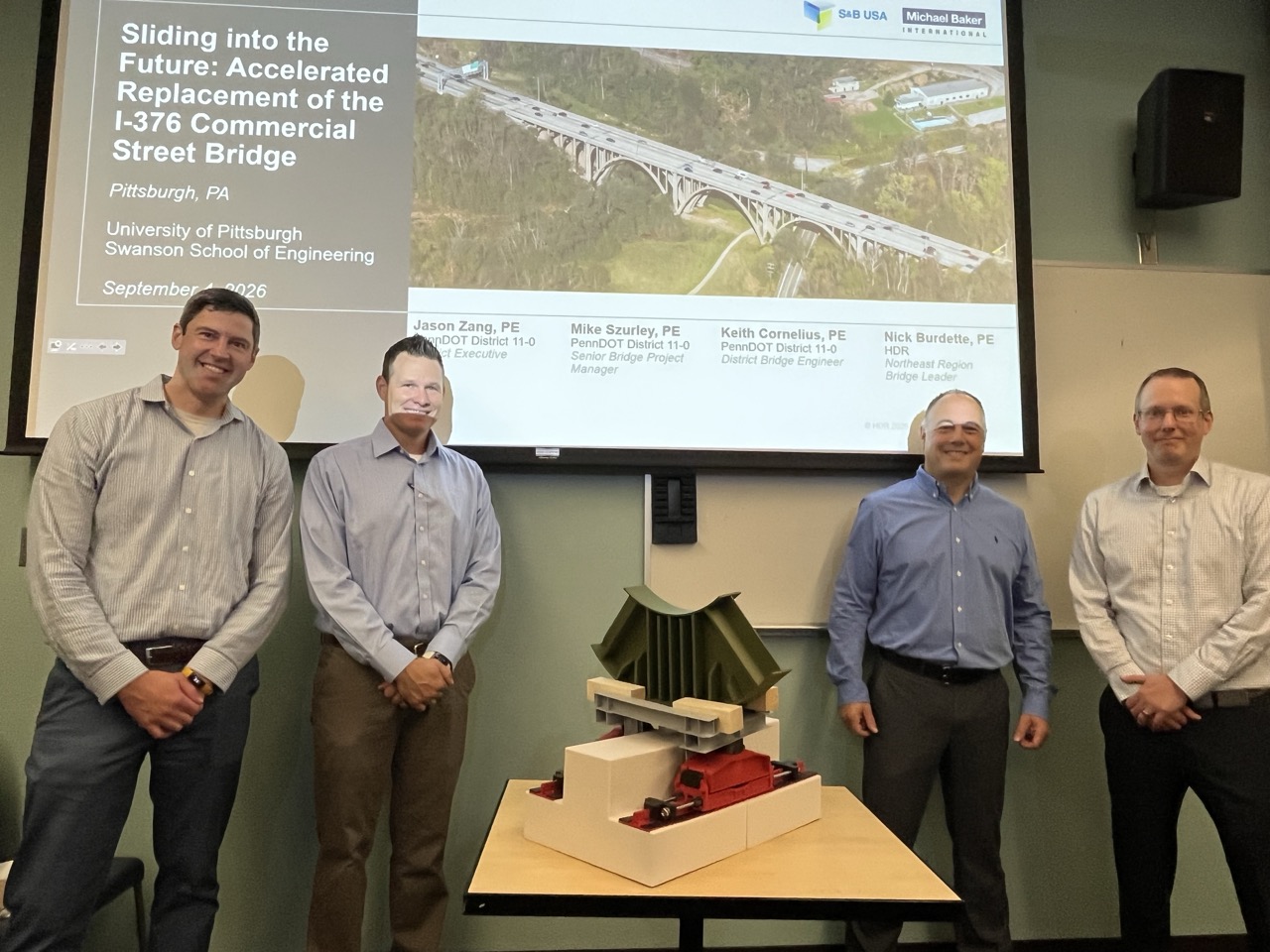
Pittsburgh’s new Commercial Street Bridge reopened on July 27, 2026, after a 17-day closure of the Parkway East, one week ahead of schedule. During that closure, crews demolished the existing bridge and slid a new structure weighing more than 10,000 tons into place, restoring a route that carries approximately 100,000 vehicles a day.
On September 4, four University of Pittsburgh alumni who helped lead the replacement visited the Swanson School of Engineering to discuss the years of engineering and planning behind those 17 days. The group included three Swanson School graduates and one graduate of Pitt-Johnstown. Their presentation, “Sliding into the Future: Accelerated Replacement of the I-376 Commercial Street Bridge,” gave graduate and undergraduate students an inside look at the operation and the collaboration that made such a complex project possible.
The speakers were:
- Nicholas (Nick) Burdette, P.E. (BS CE ’04), HDR Northeast Region Bridge Leader
- Keith Cornelius, P.E. (BS CE ’02), PennDOT District Bridge Engineer (District 11)
- Michael (Mike) Szurley, P.E. (UPJ BS CET ’03) Senior Bridge Project Manager at PennDOT
- Jason Zang, P.E. (BS CE ’97), PennDOT District Executive (District 11)
“Although the act of sliding a bridge into place is relatively straightforward, there’s more that goes into a project like this, especially due to the scale of the move,” said Kent Harries, PhD, FASCE, FACI, FIIFC, P.Eng, professor of civil engineering at the Swanson School, who organized the lecture. “This was a great opportunity for our students to understand the complex engineering and planning required to successfully pull this audacious project off.”
The speakers provided a standing-room-only audience with an inside look at what goes into a bridge replacement, especially when that bridge is a historic structure. Although the actual road closure and replacement took 17 days, the planning began in 2017.
The process involved rigorous testing of the existing structure and working closely with the city’s Historic Preservation team and other local organizations and businesses. Even before the actual move began, the project required a well-orchestrated media campaign and teams of construction workers and subcontractors building a complex structure right next to the existing bridge.
After years of preparation, the bridge closed for replacement on July 10, 2026, what Mike Szurley called “Christmas Day.” For bridge engineers, the opportunity to build a new bridge and slide it into place, dramatically reducing the inconvenience for commuters, doesn’t happen every day. Notably, Pittsburgh’s topography limits space around most bridges, which makes an accelerated replacement a rare opportunity.
The existing bridge was shut down and traffic rerouted, which allowed work crews to break up and remove the concrete deck and then implode the remaining structure. Soon, it was time to slide the new bridge into place.
Subcontractor Mammoet, a Dutch firm, had shipped powerful skid shoes and jacks across the Atlantic Ocean. The company is internationally recognized for its proprietary system that mitigates friction to securely slide large, heavy structures in a continuous motion along custom-built tracks. After months of preparation, crews slid the new bridge 96 feet on July 19 and completed the final six feet the following day.
The speakers emphasized that the success of this project came from the many teams working closely together, which included PennDOT; HDR Engineering; Fay, S&B USA; subcontractors including Mammoet; the media, and the many work crews who weathered rain, snow, cold, heat, and even smoke from Canadian wildfires to help slide a new bridge into the future.
“It was an honor to welcome these engineers to Pitt and hear their perspectives of this project,” said Vikas Khanna, professor and department chair of the Department of Civil and Environmental Engineering. “It’s gratifying to have Swanson School alumni sharing their important work with the next generations of civil engineers. Our students saw where their degrees can take them. We’re grateful that Nick, Keith, Mike, and Jason could share their insights.”
See a time-lapse video of the bridge replacement.