
In Fearless Pursuit of Technological Innovation
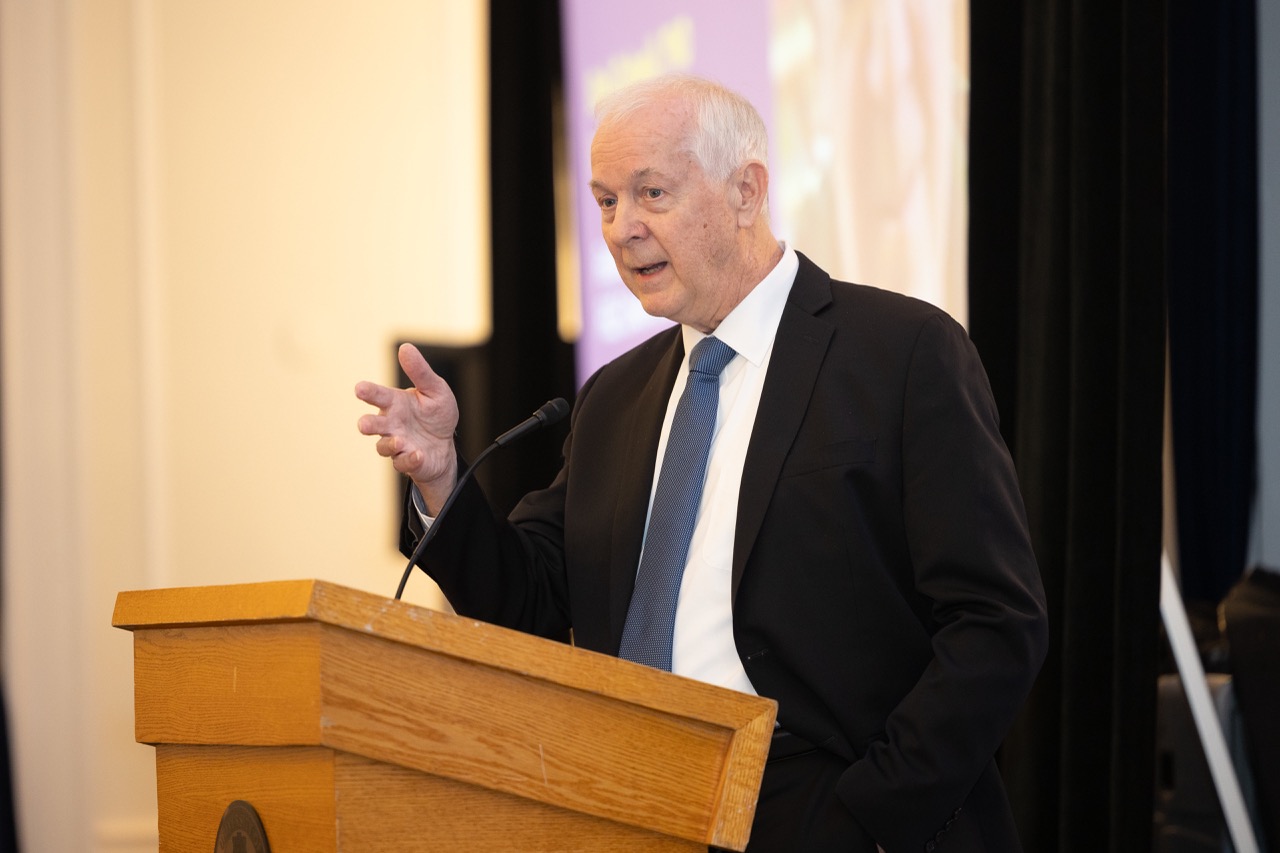
When Robert Colwell (BS EE ’77) was six years old, his mom told him he needed to pick out a musical instrument. As Colwell remembered it, she said, “You're going to college someday, and I can't pay for it. So, we’re going to teach you to play a musical instrument, and you can work your way through school.”
Colwell chose guitar. And sure enough, as an undergraduate electrical engineering student at the University of Pittsburgh, he found himself onstage at an Oakland bar, playing in a band to make extra money.
Between sets, he would finish his homework. “I remember the drummer coming up to the table one night, where I was doing calculus between sets,” Colwell said. “He just shook his head and muttered, ‘I don’t know what’s wrong with you.’”
There was nothing wrong with Colwell. He was just helping cover tuition while doing what he loved—playing guitar and pursuing his electrical engineering degree.
Colwell’s passion for electronics would guide him from his humble beginnings in Pittsburgh, where he was one of six children (half of whom became Pitt grads) in a working-class home, to a groundbreaking career designing microprocessors at Intel. He would author patents, win awards, write a book, and serve as Director of the Microsystems Technology Office at the Defense Advanced Research Projects Agency (DARPA). At every step, important mentors sparked his curiosity, challenged his thinking, and embodied qualities that would define his career.
A Wizard
Colwell credits his hometown for helping develop his mindset. “Pittsburgh was hands on, make it happen, no excuses, you know—get it done,” he said. “That was excellent preparation for going into a technology field.”
If the city helped shape him, so did his Uncle Joe. “When I grew up there in the ’60s and early ’70s, in my family, if something broke, you didn't take it to someone else. You fixed it, or you got my Uncle Joe to fix it.”
His uncle, with the help of Heathkits and Erector Sets, inspired Colwell’s fascination with electronics. And although he had no college degree, Colwell’s uncle, an electronic technician at Westinghouse, imparted something else.
“He taught me to never assume something was intellectually beyond me,” Colwell said. “He would say, ‘Someone designed that, so you can understand it enough to figure out how it works and how to maybe make it better.’”
To Colwell, his uncle seemed like a wizard. “I admired that fearlessness associated with complex technology, and that's what I'd like to pass on to anyone else.”
A Professor
If his uncle inspired Colwell’s fascination with electronics, his advisor at Pitt, Ronald Hoelzeman, an associate professor in the Department of Electrical and Computer Engineering, illuminated their inner workings.
Colwell took Hoelzeman’s Digital Logic. “Prior to that course, I understood very little about digital electronics. But in that class, I got it. I could see how it works,” Colwell said. “Ron was an extremely good teacher.” He was the first professor who supported Colwell’s instinct to design systems.
Decades later, Colwell would re-connect with his early mentor while both served on the editorial board of the IEEE publication Computer Magazine.
A Peer
Colwell’s undergraduate experience also introduced him to a peer who would later become a collaborator: Kaigham “Ken” Gabriel (BS EE ’77).
At the time, Pitt’s electrical engineering curriculum required students to write 40 to 50 pages of handwritten equations as circuit analysis homework. As Colwell recalled, “I’d get bored. I’d start to move faster, skipping steps. I inevitably made mistakes.”
He noticed the work of a fellow student, whose equations were written out immaculately on lined engineering pads. “It was like it came out of a printer,” Colwell said. “I sensed that I needed to meet this guy, so I introduced myself. I said, ‘You’re the guy who screws up the curve when they grade the tests. So who are you?’”
The two became good friends.
Gabriel imparted advice that stuck with Colwell. “He told me that if you struggle at all with something, don’t skip any steps—don’t be lazy. Draw them out, line by line.”
The discipline proved invaluable as Colwell went on to earn his computer engineering PhD from Carnegie Mellon University and begin designing and innovating at Bell Labs, PERQ Systems, Multiflow, and eventually Intel, where he would become the Chief Architect responsible for Intel’s Pentium P6 microarchitecture in the 1990s.
In the 2010s, Gabriel would recruit his former Pitt classmate to join him at DARPA, where Colwell would guide high-impact technological innovation and meet remarkable people like a space shuttle astronaut and an SR-71 Blackbird pilot. He would also get to fly in an F-16 fighter jet and land and take off from an aircraft carrier.
A Colleague
“One of my theories, which I pass on to any engineering student who wants it, is that the best thing you can do for yourself and your career is to find the best possible people and latch onto them. Be nice to them,” Colwell said.
That philosophy led him to another collaborator, David Papworth, a colleague at Multiflow and later at Intel.
“When you design a microprocessor,” Colwell said, “every day you're faced with a hundred decisions about the product, and each one represents an important tradeoff.”
Constrained by time and money, Colwell valued having “a genius” who would help navigate the most difficult tradeoffs. “Dave's one of those people who's just, you know, God knows where his brain came from.”
Commitment, Kindness, and Curiosity
Figures like Hoelzeman, Gabriel, Papworth, and especially his uncle shaped Colwell’s trajectory, and they embodied qualities that he has found essential to his success.
First is commitment. “It may seem obvious,” Colwell noted, “but if you're unwilling to throw yourself at the problem, what are you doing?”
Second, which years of leading teams taught him, is kindness. “People don’t create in a vacuum anymore, and if your peers hate you, your output will go down. It’s also just the right thing to do.”
And finally there is fearless curiosity—the desire to take something apart and make sense of it.
“I like creating,” Colwell said. “I like starting with something that is nothing and turning it into something useful or pretty.”
Indeed today, when he’s not consulting with industry and academia, he loves working with his hands, building furniture and restoring analog synthesizers. He still plays guitar, too, and can knock out those old songs that once helped him pay his way through Pitt.