
Pitt Researchers Reveal How Tiny Swimmers Disrupt Ocean Flow: APS Recognizes Top Fluid Dynamics Paper of 2024
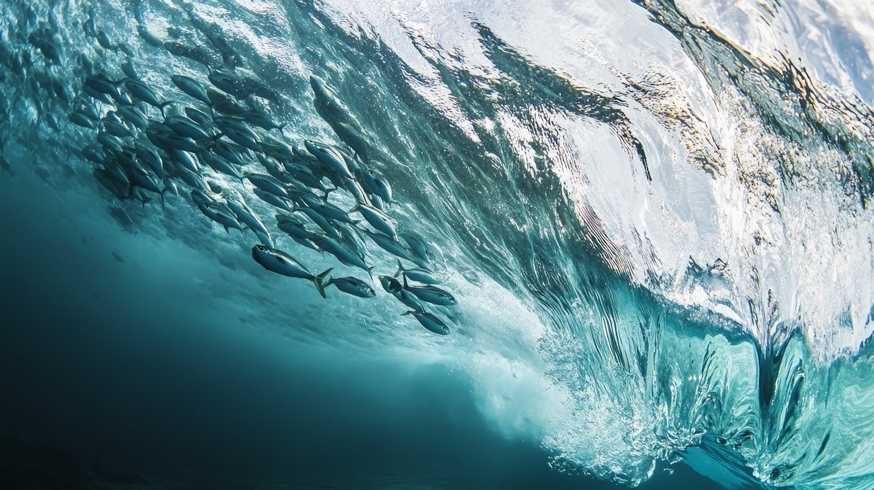
Any beachgoer who has ever fought against a current while swimming might be skeptical that schools of baitfish, tiny shrimp, or even zooplankton could alter that powerful pull. Yet recent research by Lei Fang and his PhD student Xinyu Si of the University of Pittsburgh Swanson School of Engineering shows how tiny active swarming matter can indeed affect flow structures.
Fang and Si’s results, “Interaction between swarming active matter and flow: The impact on Lagrangian coherent structures” (DOI: 10.1103/PhysRevFluids.9.033101), were published in Physical Review Fluids in March 2024. The American Physical Society included this important research in its collection of Top Papers of 2024, which were among the most downloaded.
Fang, an assistant professor in civil and environmental engineering, and Si explore the extent to which active matter in the ocean can alter Lagrangian coherent structures (LCSs). In bodies of water or the atmosphere, LCSs are the structures created by the flow of a current—they are the coherent patterns that appear in the seeming chaos of turbulence.
Either hyperbolic or elliptic, these structures serve as a backbone of the flow and create barriers. Hyperbolic LCSs create stronger barriers that a flow cannot penetrate. In coastal waterways, these LCSs transport and organize inactive matter like water, storm run-off, or even oil.
For facilities such as bioreactors or desalination plants on coastlines, or even nearshore aquaculture farms, where huge schools of fish must be fed and their waste removed, understanding LCSs can help ensure safer, cleaner waterways.
However, many unknowns remain. For Fang and Si, one unknown was whether and to what extent tiny swarming active matter affected LCSs. “The ocean is filled with small fish, shrimp, zooplankton, and bacteria,” said Fang. “Yet there has been little research into the ways this active matter and turbulence flow interact.”
“Previously, we studied how LCS organize small active matter,” said Si, first author of the paper. “For this research, we wanted to find out how this active matter can alter LCSs, especially hyperbolic LCSs.”
Modeling the impact of active matter
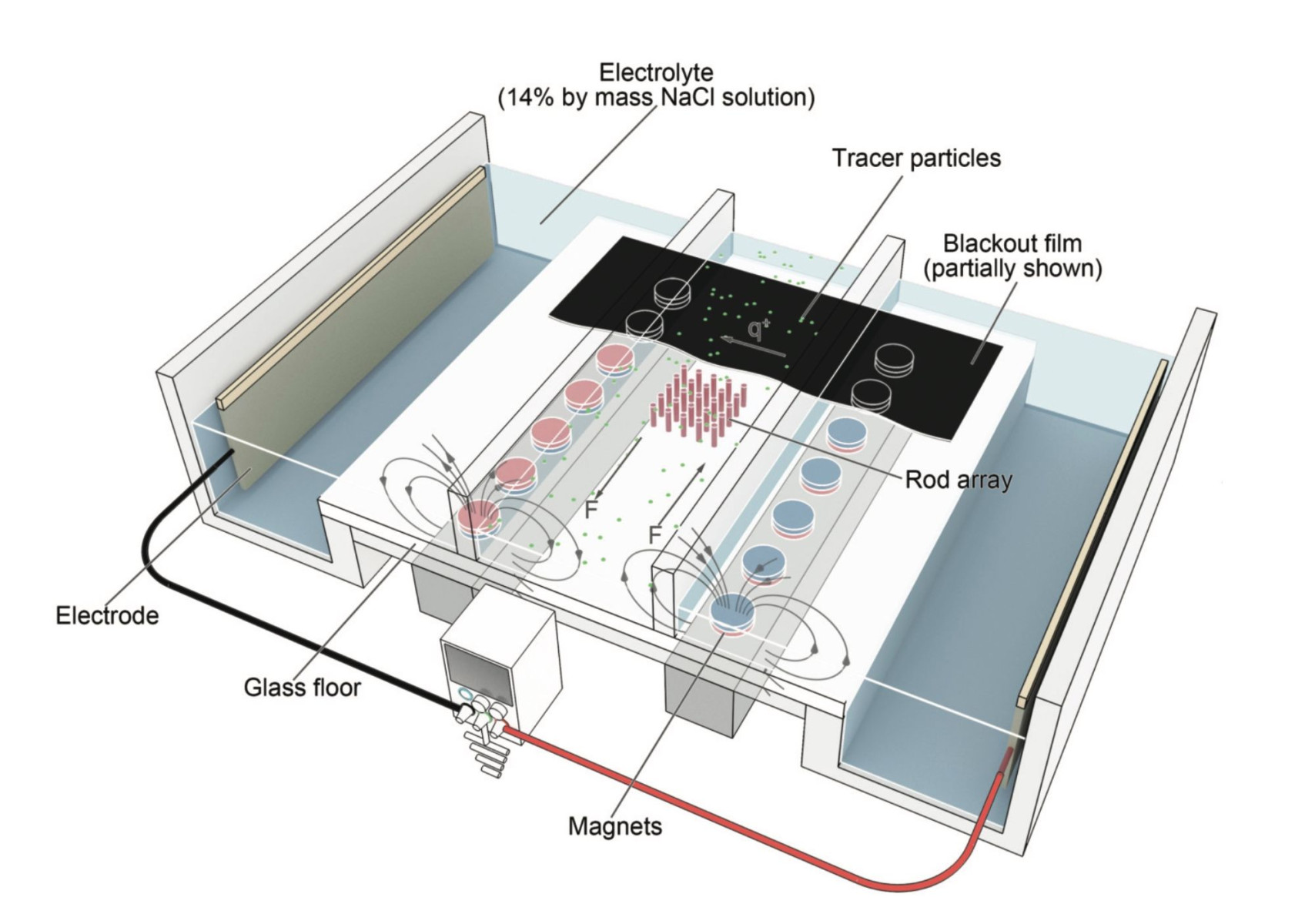
To model a quasi-two-dimensional flow, Fang and Si built a testing structure with copper electrodes on opposing sides and magnets in the underside. On a thin layer of salt water, they measured the effects of tiny swimmers on LCSs, in this case adult-sized Artemia salina (brine shrimp), approximately 15 millimeters long.
“Some people think that many small swimmers in large LCSs just add random noise—that it’s such a small amount of energy that it would average out over time—but our research shows that even tiny shrimp can affect the structure,” said Fang.
Fang and Si found that tiny active matter introduces new energy that alters the boundary of hyperbolic LCSs and that can break elliptic LCSs. They even found that when they reduced the density of the swarming active matter, the LCS was still affected.
For Fang, who also received a National Science Foundation (NSF) grant in 2024 to explore how tiny active matter can create turbulence in the ocean, this research sheds new light on the complexity of flow.
“For people studying turbulence and those concerned with coastal waterways and the distribution of inactive matter near coastlines, it’s important to consider not just how active matter moves—but how that movement impacts flow,” said Fang. “While they may be tiny, these organisms can make a difference far beyond their size.”