
Award-Winning Packaging
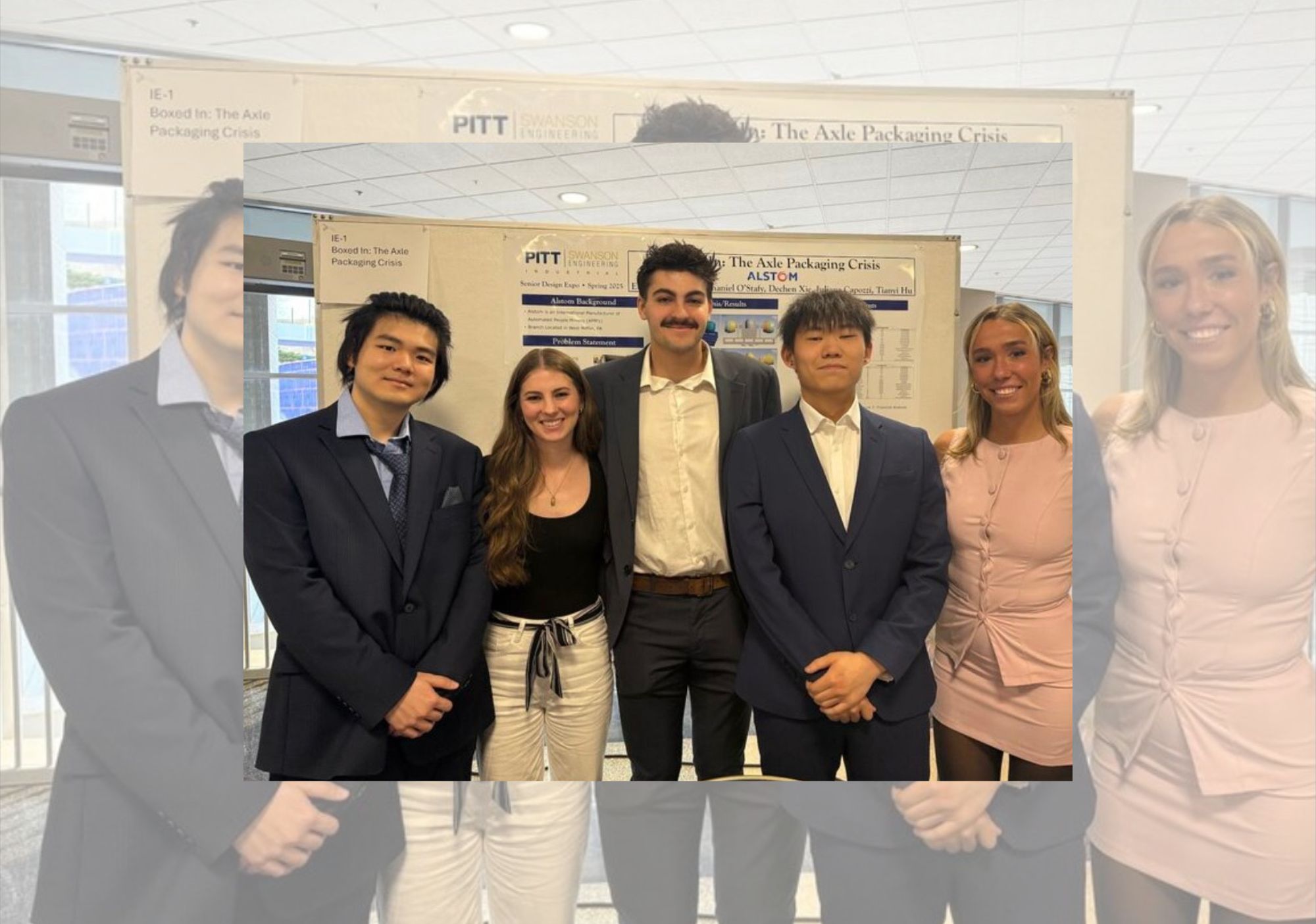
Photo above (L - R): Dechen Xie, Emily Bosworth, Nathaniel O'Stafy, Tianyi Hu, and Juliana Capozzi
This past spring for their Senior Capstone Project, five University of Pittsburgh industrial engineering students worked with Alstom, a worldwide rail technology company with a plant in West Mifflin, PA, to solve a real-world packaging problem: 1,350-pound axles for their airport trams were arriving from their American-based supplier overturned and damaged.
The Pitt team of Emily Bosworth, Nathaniel O'Stafy, Dechen Xie, Tianyi Hu, and Juliana Capozzi developed and presented three solutions. Their proposal, with design elements that Alstom has begun to implement, recently won third place in the prestigious MHI College-Industry Council on Material Handling Education (CICMHE) Capstone Design Competition.
Alstom is a leading manufacturer of trains, automated people movers (APM), monorails, and more. In West Mifflin, the company builds APMs for airports, but it has encountered issues with expensive, heavy axles, which too often arrive damaged and thereby slow production and increase costs.
The company was looking for new ideas the supplier could implement that would increase protection while reducing waste through reuse.
“We toured the facility and saw how Alstom manufactures their trams,” said Bosworth. “We got to see half-built trams and ride in one on their test track.”
After meeting with the Alstom team, the students set to work brainstorming and using computer-aided design (CAD) to assess the current packaging and develop new models. Throughout the process, they communicated with Alstom engineers and developed three solutions, which addressed the company’s need while providing flexibility.
The result was their presentation “Boxed In: The Axle Crisis & Refining the Handling Process.”
Based on the strength of this project, Bopaya Bidanda, the Ernest E. Roth Professor of Industrial Engineering, encouraged the team to enter MHI’s CICMHE competition. MHI is the largest materials handling, logistics, and supply chain association in the US.
“These students did a fantastic project,” Bidanda said. “They worked cohesively and creatively to develop three designs, which impressed Alstom.”
It also impressed the judges, who cited the data-driven methodology and the practical engineering solution it provided as some of the defining strengths of the project.
By placing third, the team received a cash prize and a new accolade. More importantly, they gained valuable, hands-on experience that continues to guide them as they are pursuing graduate degrees or beginning their careers in industry.
“The project challenged me,” said Bosworth. “Though I’d done internships, I’d never had this level of engagement with a company to help develop a solution. Having the opportunity to communicate with engineers and floor workers has been so useful now in my current role at U. S. Steel.”