
Turning Crisis into Compassion During Brazilian Floods
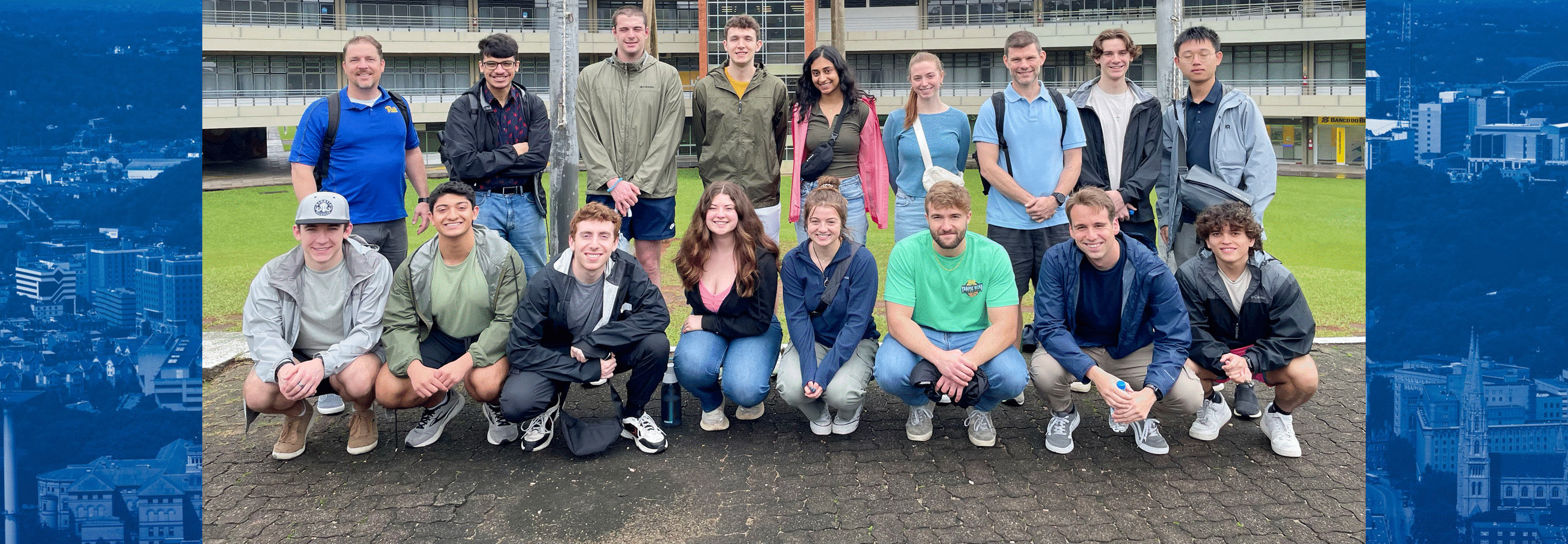
Planning for different circumstances is important when traveling – but how can one expect a natural disaster, especially when abroad? Students and faculty from the University of Pittsburgh Swanson School of Engineering faced that challenge head-on this spring when members of Pitt’s Exploration of Energy and Electrification Global Experiences program were caught in the catastrophic flooding of southern Brazil.
Within days of the group’s arrival in Rio Grande do Sul on Sunday, April 28, 150,000 Brazilians were displaced throughout Brazil’s southernmost state. At the height of flooding in mid-May, the International Labor Organization said that number had skyrocketed to nearly 700,000.
Felipe Junqueira, a senior studying electrical engineering, was born in São Paulo, Brazil, just northeast of the flooding.
“While it is common for tropical cities like Rio de Janeiro or São Paulo to take on a few feet of floodwater during heavy rainfall, seeing infrastructure fail to the point where bridges collapse, roads are washed out, and power grids shut down are shocking,” he said.
Indeed, less than a week after their arrival, the runways at Salgado Filho International Airport in the state capital of Porto Alegre were completely underwater, and the program’s scheduled activities and site visits around São Leopoldo were quickly canceled.
Witness to Disaster
While waiting to secure transportation out of the city, program directors Robert Kerestes, associate professor and undergraduate program director of Pitt’s Department of Electrical and Computer Engineering, and Tony Kerzmann, associate professor of mechanical engineering and materials science, were surprised to see how eager students were to help refugees arriving in São Leopoldo.
When Unisinos – the program’s partner institution – opened its doors to approximately 1300 refugees on Saturday, May 4, Kerestes and Kerzmann suggested the group aid their relief efforts. The students were quick to lend a helping hand.
Students folded and organized donated clothes, distributed bedding supplies, helped to move furniture, and made themselves as helpful as possible.
Junqueira said it was devastating to know he would be able to go home soon when other Brazilians were still trapped and waiting to take refuge.
“My peers are fortunate to have never experienced the rampant poverty in areas like this,” Junqueira said. “I was one of the only members in our group able to speak Portuguese with the refugees, and it was gut-wrenching to hear them and look in their eyes knowing what little they had was taken away.”
Cassidy Laffey, a rising junior studying environmental engineering, said that it’s one thing to see disasters on the news, but another thing entirely to experience one firsthand.
“The lives of these refugees had just changed forever, but all I could do was bring them a blanket,” Laffey said. “It seems very privileged for me to say the hardest thing I’ve ever done was pull myself together and help out as best I could.”
Unisinos faculty noted the Pitt students’ decision to help was an organic response to the catastrophic events they watched unfold.
“This kind of decision-making is something we expect to see from undergraduate students,” said Tatiana Louise Avila de Campos Rocha, assistant director of undergraduate affairs at Unisinos. “I know the kind of character Pitt teaches their students, so we weren’t surprised to see them volunteer. Soft skills like teamwork, kindness and empathy are critical in understanding the human condition as an engineer.”
In Dark Times, There is Always Light
The close-knit, supportive atmosphere among the refugees resonated with the students. Justin Winslow, a rising junior studying civil engineering, said that the selflessness and generosity he witnessed at Unisinos – by volunteers and refugees – initially surprised him.
“As we were setting supplies on the floor, I flashed back to the COVID-19 situation in the United States where people would ransack store shelves for supplies,” Winslow said. “But there was no rush or panic to hoard supplies. I could see in the way people acted how much they still cared about their neighbors.”
This kind of community mindset didn’t surprise Joseph Rivera, a rising junior studying electrical engineering and a proud member of the Latino community.
“As a Puerto Rican, I know the Latino community is always there for each other,” said Rivera. “It was beautiful to see the Brazilian community support each other the same way Puerto Ricans did after Hurricane Maria in 2017.”
Reflecting on an Unexpected Experience
After securing transportation out of the affected area on Monday, May 6, Kerestes and Kerzmann led the group to Florianopolis where they spent a day at Armaçāo Beach to decompress and reflect on what they had experienced. They finished their trip at the Itaipu Dam – the second leading producer of hydroelectric power in the world – in Foz do Iguaçu to round out the program’s purpose of exploring energy alternatives.
“We felt bonded after leaning on each other for support during the humanitarian efforts,” Laffey said. “After seeing the devastation of the flooding, one of our collective takeaways is that the small inconveniences we encounter daily don’t matter. We all feel extremely appreciative of our lives and the opportunities we have here at home, and we were so grateful to make the most of the last few days of our trip.”


Throughout their time in Rio Grande do Sul, Kerestes and Kerzmann were in contact with the Pitt Global Experiences Office (GEO) to ensure the safety and security of all program members. The volunteering efforts were cleared by the GEO and are similar to efforts that occur through the GEO-operated service-learning programs.