SHREC Enters the New Frontier of Space Research at Pitt
The National Science Foundation Center for Space, High-Performance, and Resilient Computing, or SHREC, is approaching lightspeed as the University of Pittsburgh expands its space research initiatives.
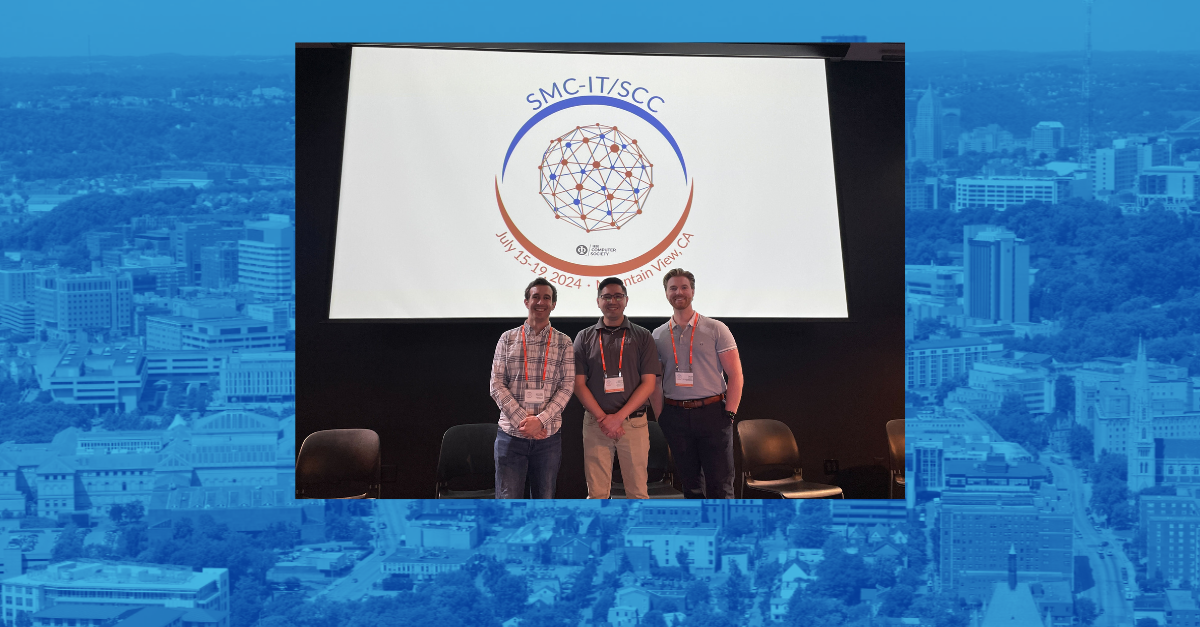
The research group recently attended two major space conferences this past summer: the joint IEEE Space Mission Challenges for Information Technology (IEEE SMC-IT) and the Space Computing Conference (SCC), as well as the Small Satellite Conference (SSC), to demonstrate to attendees the capabilities and most recent research produced by the center.
“This is an exciting time for Pitt’s launch into space research and workforce development,” said Alan George, R&H Mickle Endowed Chair and Professor and Department Chair of Electrical and Computer Engineering (ECE) and founding director of SHREC. “Having a presence at these conferences greatly contributes to Pitt being recognized as a national hub for this type of knowledge and exploration. What is especially inspiring is that our amazing graduate students are Pitt’s ambassadors because they have the hands-on knowledge and experience to present these advances.”
IEEE SMC-IT/SCC
The IEEE SMC-IT/SCC conferences, especially SCC, showcase a wide range of cutting-edge research areas pursued by the ECE department and SHREC, such as onboard processing, autonomous operations, innovative computing architectures for space, fault-tolerant computing, radiation effects on complex devices, and advanced memory technologies. These technologies have been developed by SHREC and applied thus far to three mission experiments on the International Space Station, with the Pitt campus serving as Mission Control.
SHREC presented three research papers at this joint space conference:
- “Reliable, ML-Based Image Processing and Compression for An Accelerated Onboard Imaging Pipeline,” which focuses on an AI-based data compression system that SHREC developed to improve data downlink speeds and make more efficient use of onboard storage resources.
- “Toward a Radiation-Tolerant Display System,” which is a collaboration between SHREC and NASA on developing new astronaut displays for deep space.
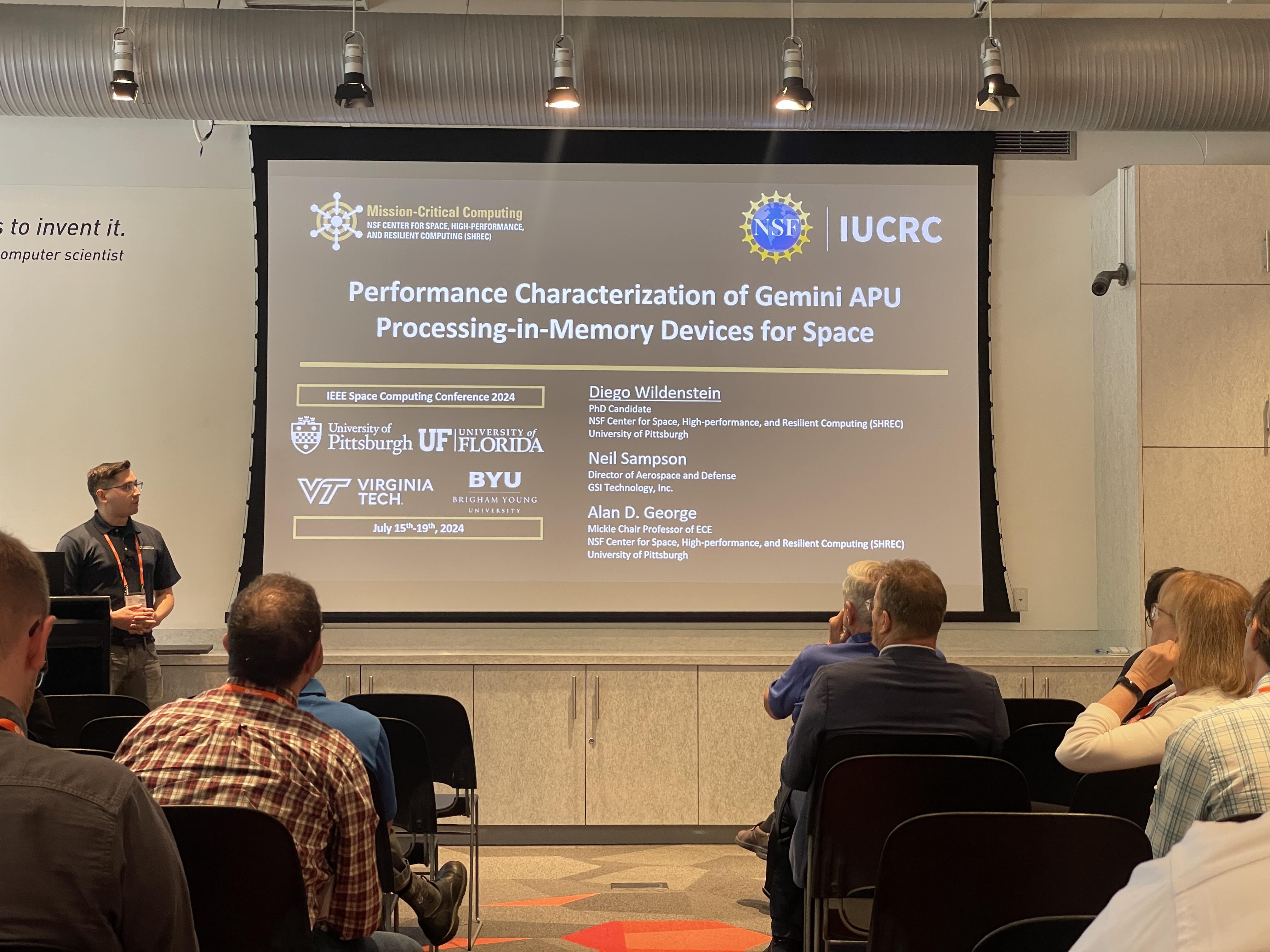
- “Performance Characterization of Gemini APU Processing-in-Memory Devices for Space,” which explores a new kind of hardware architecture that can be used in orbit.
Additionally, new alumnus Tyler Garrett MSECE ’18 PhD ECE ’24 participated in the workshop panel “Balancing Performance, Fault-Tolerance, and Security for Future Space Systems,” and presented “Advancing Onboard Processing and Sensing Capabilities Through Radiation-Tolerant Commercial-Off-The-Shelf (COTS) Hybrid Design Methods.” The presentation covers the evolution of SHREC’s space missions, technologies, and research efforts from Pitt’s perspective. Other panelists included members from NASA, NASA Jet Propulsion Laboratory, European Space Agency, international universities, and Airbus.
“The knowledge gained from our experience at these conferences, along with our years of experience in space computing, allows us to better equip our Pitt colleagues with the processing capabilities required to enable other areas like medicine, engineering, and science to achieve their own research objectives,” Garrett said.
The IEEE SMC-IT/SCC was also attended by fellow SHREC contributors and PhD students Michael Cannizzaro and Diego Wildenstein.
Cannizzaro used the opportunity to learn more about Microchip Technology’s High-Performance Spaceflight Computing (HPSC) processor chip, a novel space-qualified processor that will soon be available to the space industry, while Wildenstein presented SHREC’s research alongside Garrett.
“Attending conferences like these is critical to help grow Pitt's space research program,” Wildenstein said. “The exchange of ideas during conferences like this helps us to better understand the direction and needs of the space community so that our research can build off of that. It is also helpful to present our research in front of the greater space community, which provides us with important feedback and new ideas on how we can continue to improve.”
Small Satellite (SmallSat) Conference
A small satellite is even smaller than a mini-fridge, which makes them all the more complicated to launch into space.
The SmallSat Conference is an opportunity for researchers to explore how “automation is being integrated into small satellite systems across space, launch, ground, and user segments.”
SHREC hosted a booth on the main convention floor, showcasing their research at Pitt. Both Wildenstein and PhD student Ian Peitzch presented papers. Wildenstein focused on data compression using AI, while Peitzch delved into image processing and classification.
PhD students and SHREC contributors Linus Silbernagel and Cannizzaro were also in attendance. Cannizzaro noted how conferences like SmallSat help build connections and engage with the space community that directly impacts their work, including with other universities and labs.
“We work a lot with industry,” Silbernagel said. “They help drive our research, so when people discover our booth, we use that opportunity. And boom. We have new connections and potentially new collaborators.”
Wildenstein added that the experience is “inspiring.”
“We can take what they’ve done and take what we’ve done and see if there’s any way to collaborate or possibly spur any ideas for what we can do in the future,” Wildenstein said.